


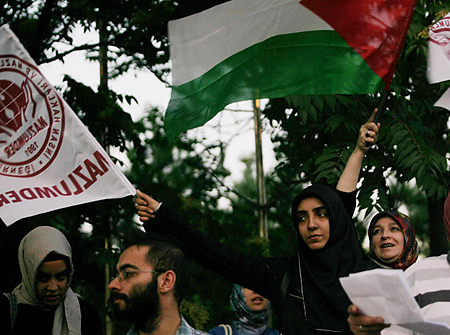
Pro-Islamic Turks stage a protest to show their solidarity with Palestinians and to protest against Israel on the "Jerusalem Day" outside the Israeli embassy residence in Ankara on August 26, 2011. (Photo: Adem Altan / AFP / Getty Images)
Many are the challenges facing Israel on the cusp of a new season.
The Palestinians’ approach to the United Nations for statehood looms. The bid, set for Sept. 21, bears down on Jerusalem with the certainty of an autumn chill.
The weekend desecration of the Israeli embassy by a Cairean mob was one of those shocks that is not quite a surprise, given the longstanding antipathy of the Egyptian public toward the Jewish State. More telling was the response of the Egypt’s military rulers, who according to Israeli officials went missing during the hours that mobs laid siege as Israeli guards awaited rescue from Egyptian commandos who didn’t show up til 4 a.m. How fraught are relations between Egypt and Israel? On Sunday, an Israeli army vehicle patrolling near the site of the Aug. 18 terror attack near the resort city of Eilat took fire from the Egyptian side of the border. The Israelis did not return fire. Who knew who was shooting at them?
And yet, the trash talk with Turkey qualifies in many ways as the great crisis of the moment. It’s not just that Turkey’s Prime Minister was threatening to send warships to confront the Israeli naval blockade of the Gaza Strip, calling the 2010 deaths of eight Turks at the hands of Israeli commandos “a casus belli,” or act of war. Nor is it reports that, in response, Israel’s reliably bellicose Foreign Minister, Avigdor Lieberman, mulled aloud about reaching out to the Kurdistan Workers’ Party, or PKK — regarded by the U.S. as a terrorist organization — just to mess with the Turks.
It’s that, not five years ago, these two countries were not merely allies, but strategic allies, the kind a nation forms a foreign policy around.
“Israel-Turkey relations were great up to three or four years ago,” recalls Dan Haloutz, a former chief of staff for the Israel Defense Forces. “When I was a commander, I used to fly to Turkey on every military training we had with the Turkish air force, and we had a lot — a lot.”
The ties were snug, and at least appeared essential. Israel hasn’t a lot of air space, and so was grateful for access to the wide open skies over Anatolia for fighter pilots to log flight hours. In return Turkey bought Israeli tanks, and still relies heavily on Israel’s remote controlled drones to track and attack the very PKK rebels the foreign minister reportedly was looking to cultivate. Away from government, commerce runs at least $3 billion a year between the countries.
And though 99 percent of Turks are Muslims, Jews have been long welcome in Istanbul, not least since the Spanish Inquisition, when the Ottoman sultan gave refuge to those offered the choice of conversion to Christianity, death or expulsion. Some still speak Ladino, or “Jewish Spanish.” Even after 9/11 Israelis felt safe enough in Turkey to flock to its Mediterranean discount resorts; the departures board at Ben Gurion Airport on a summer day lists charter flight after charter flight to Antalya.
That abruptly changed on Memorial Day, 2010, when Israel’s version of the SEALs boarded the Mavi Marmara. The converted ferry was en route to supply the besieged residents of Gaza, an act that ostensibly violated Israeli sovereignty. These were the people about whom Turkish Prime Minister Recep Tayyip Erdogan had angrily lectured Israel’s head of state at Davos a year earlier, in the wake of the three-week Israeli military incursion that left 1,400 Palestinians dead.
After the flotilla fiasco, charters to Turkey were cancelled overnight, and Israel began steering its tourists toward Greece. But things really did appear to be on the mend this summer. In June, Turkey joined Greece in preventing the makings of a new flotilla from leaving their ports to challenge the Gaza blockade anew. Behind the scenes, Israel dispatched diplomats to hammer out language that would salve the wounds to Turkey’s quite extraordinary national pride and finally put the 2010 deaths behind both countries, who said they wanted to be friends again. “Turkey welcomes you,” said the resort ads that began appearing in Israel. In smaller print: “As always.”

The negotiations, however, ended not in language acceptable to both sides but in the release of a United Nations report on the flotilla that found fault with both sides but simply outraged Turkey. Israel’s ambassador to Ankara was formally expelled to Jerusalem. He was joined the following week by Israel’s ambassador to Egypt, who merely fled. And on Monday, Erdogan arrived with great fanfare in Cairo.
The days are growing shorter.