


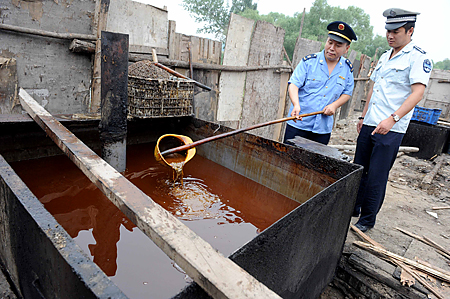
Police inspect illegal cooking oil seized during a crackdown in Beijing on August 2, 2010 (Photo: AFP / Getty Images)
Among the list of food safety scandals that have plagued China in recent years—toxic infant formula, pesticide-tainted vegetables, exploding watermelons, “lean meat powder” and pork reconstituted as beef—few are quite as stomach churning as the nauseatingly-named “gutter oil.” It involves, as the name implies, the resale of used cooking oil that has been scooped from sewers or bought from restaurants by criminals. A crackdown announced Tuesday by Chinese police gives a sense of the scope of the problem. In a six-month investigation spread across 14 provinces, police say they broke up six illicit oil recyclers and arrested 32 suspects. The authorities recovered 100 tons of gutter oil they say was being processed for resale.
With China’s size and the heavy reliance on oil for many popular dishes, proper disposal of used oil is a big problem. China consumes about 22.5 million tons of cooking oil annually, and as much as one out of every ten restaurant meals has been cooked in waste oil, He Dongping, a professor at Wuhan Polytechnic University, told state media last year. Aside from the ick factor, there are serious health concerns associated with gutter oil. It can be contaminated with the fungus aflatoxin, which can contribute to the risk of liver cancer. This page at the U.S. National Institute of Environmental Health Sciences looks at the correlation between chronic aflatoxin exposure and liver cancer rates across the world. It’s striking how high liver cancer rates are across Asia, including China, and in parts of Africa. Waste oil is not the only source of aflatoxin, but its prevalence in China clearly adds to the problem here.
There are legitimate uses of used cooking oil, including as biodiesel. The Jinan Green Bio Oil Company in Shandong, was ostensibly a biodiesel firm, though it is accused of reprocessing gutter oil for more lucrative sales back into food markets. Investigators found 70 tons of “gutter oil” in various stages of processing at the company.
The gutter oil crackdown is just part of a broader effort to control China’s continuing food safety worries. As we wrote earlier this summer, the crackdown has been making headlines with more than 2,000 arrests. But such strike-hard tactics are only part of the equation, and cleaning up the food chain in China will require sustained effort. As food safety expert He Dongping noted last year in an interview with the China Youth Daily (republished here by the official China Daily), it might take ten years before the country cleans up its gutter oil problem. That’s hardly reassuring for Chinese consumers.
Austin Ramzy is Beijing correspondent for TIME. Find him on Twitter at @austinramzy. You can also continue the discussion on TIME’s Facebook page and on Twitter at @TIME .