


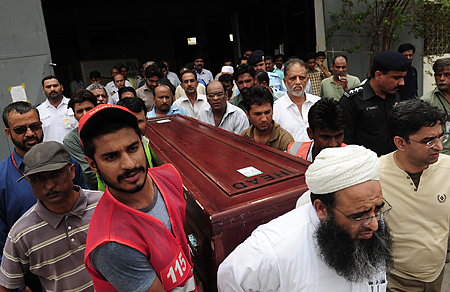
Relatives and members of the media carry the coffin of Pakistani journalist Syed Saleem Shahzad at the airport in Karachi on June 1, 2011. (Photo: Asif Hassan / AFP / Getty Images)
Dexter Filkins’s deeply reported piece in the New Yorker on the assassination of Pakistani journalist Syed Saleem Shahzad earlier this year is worth the read. Yes, it covers territory we’ve all trod across — the likely involvement of Pakistan’s military intelligence agency, the ISI; the confused allegiances of the Pakistani army as a whole; the total breakdown of trust between the Americans and Pakistanis in recent months. But there are some particularly striking snippets of Filkins’ own reporting that reinforce how problematic the ISI’s role has been in the years preceding and following 9/11.
Describing his own meeting with Shahzad, which took place nine days before the journalist’s abduction and murder, he recounts an exchange related to him by Shahzad of what happened when the latter was called in by ISI officers to answer for controversial claims in a recent story of his. Filkins writes:
The lead man, he said, was a naval officer, Rear Admiral Adnan Nazir, who serves as the head of the I.S.I.’s media division.
“They were very polite,” Shahzad told me. He glanced over his shoulder. “They don’t shout, they don’t threaten you. This is the way they operate. But they were very angry with me.” The I.S.I. officers asked him to write a second story, retracting the first. He refused.
And then Admiral Nazir made a remark so bizarre that Shahzad said he had thought about it every day since.
“We want the world to believe that Osama [bin Laden] is dead,” Nazir said.
Why would the ISI want the world to believe such a thing? Whatever one’s speculative answer, it can’t be good. A lot of ink has already been spilled on the implications of bin Laden’s presence in Abbottabad, under the nose of Pakistan’s top military academy. But Filkins goes on to detail other alleged collusion between the ISI and al-Qaeda or al-Qaeda-aligned militants.
He details an interview earlier this year with Fida Muhammad, an ex-ISI officer held in detention in Afghanistan:
Muhammad told me that his most memorable job came in December, 2001, when he was part of a large I.S.I. operation intended to help jihadi fighters escape from Tora Bora—the mountainous region where bin Laden was trapped for several weeks, until he mysteriously slipped away. Muhammad said that when the American bombing of Tora Bora began, in late November, he and other I.S.I. operatives had gone there, and into other parts of eastern Afghanistan, to evacuate training camps whose occupants included Al Qaeda fighters.
“We told them, ‘Shave your beards, change your clothes, and follow us,’ ” Muhammad said. “We led them to the border with Pakistan and told them they were on their own. And then we went back for more.”
Yet, in this same article, Filkins admits that Pakistan’s army chief Gen. Ashfaq Kayani and the ISI head, Gen. Ahmed Shuja Pasha, are two of the closest allies the U.S. can count on in a region that continues to be one of Washington’s greatest diplomatic headaches. He bemoans the creeping “Islamization” that has taken place within the Pakistani military, but neglects to mention that much of this radicalization crept in under the benign watch of the U.S., a cozy ally of the regime of Gen. Zia-ul-Haq, an Islamist-friendly military autocrat. Filkins shines more light on a particularly dark episode in this year’s news, but it serves, in truth, to only deepen the gloom.