


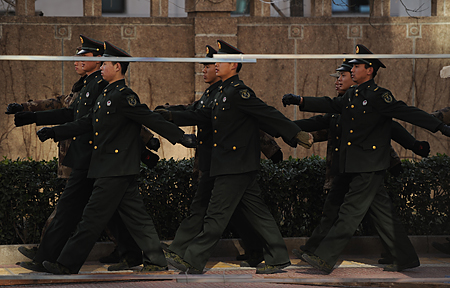
PLA soldiers march in front of the apartment complex where jailed Nobel peace laureate Liu Xiaobo's wife lives in Beijing on December 10, 2010. (Photo: Peter Parks / AFP / Getty Images)
One of the great surprises about the widespread crackdown on dissent in China this spring was how many of those who were detained and later released have remained quiet. While the experiences of a few who were detained, such as the artist Ai Weiwei, did emerge, little is known about what was endured by many of the more than 100 others who were rounded up. Certainly some were threatened with further punishment if they talked, but these aren’t the sort of people who quail in the face of intimidation.
Now one of the disappeared has spoken in detail about his experiences. Jiang Tianyong, a Beijing lawyer who has defended members of religious minorities and handled other sensitive cases, described his two-month detention in an interview with the Hong Kong-based South China Morning Post. (The story is here, behind a pay wall; a shorter, free version is available here.) Jiang says he was forced to awake at 6 a.m. and begin reciting patriotic songs, repeating them until he got the words right. Then he was required to sit facing a wall to “reflect.” The paper says that for at least five days Jiang was interrogated throughout the evening and not allowed to sleep.
Equally troubling was that Jiang had not been officially arrested and was thus not allowed the legal protections he should have been granted. His jailers threatened him with even greater harm if he didn’t cooperate. The SCMP story continues:
“You know your life is in our hands? So is your wife’s and your child’s,” they said. “If you co-operate, perhaps the government will be more understanding.
“Don’t even dream about being transferred to a detention centre, or getting tried in a court. If we beat you to death and bury you, all it means is dirtying a piece of land.”
Jiang’s story emerged this week just as another dissident, legal activist Yang Maodong (who is also known by the pen name Guo Feixiong) was released after serving a five-year term for “illegal business activity” related to a book he published on corruption in the northeastern city of Shenyang. According to Human Rights in China, an NGO, the 45-year-old Yang suffered extensive physical abuse at the hands of Shenyang and Guangzhou police while in detention. He once underwent questioning for 13 days and nights without sleep, was shackled to a wooden bed for 42 days, and hung from a ceiling while his genitals were shocked, the group says in a report on its website. While in prison he was once “beaten by an inmate while 200 others watched,” according to HRIC.
In an interview this week with the Associated Press, Yang declined to describe the details of his treatment but said he was “given special treatment beyond people’s imagination.” Yang said that he would continue his efforts to encourage political reform and rule of law in China, despite his experiences behind bars. “I am still the same person as five years ago. No amount of ‘special treatment’ [in prison] would make me more radical or weaken me,” he told HRIC. “My conviction in defending the rights of people has not changed in the slightest.”
Austin Ramzy is Beijing correspondent for TIME. Find him on Twitter at @austinramzy. You can also continue the discussion on TIME’s Facebook page and on Twitter at @TIME.