


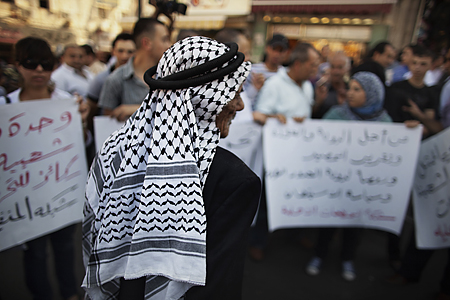
An elderly Palestinian takes part in a anti-US demonstration in Ramallah on September 15, 2011. (Photo: Marco Longari / AFP / Getty Images)
Slowly and possibly surely, the Palestinian approach to the United Nations endgame is emerging. And it sizes up as a relatively moderate strategy, one that suggests holding back on any attempt to charge Israel in newly available international courts as long as Israel stops expanding its settlements on Palestinian territory.
That, at least, was the strategy was laid out Thursday morning by Riyad Al-Maliki, the foreign minister of the Palestinian Authority. Like PA President Mahmoud Abbas, the foreign minister says the Palestinian leadership remains adamant about at least trying for full U.N. membership even though their application will be slapped down by the United States, which has vowed to use the veto at its disposal as a permanent member of the Security Council, where applications for full membership must first pass.
The Palestinians want the pomp and formality of applying for full membership, and the benefit of whatever political pressure gathers behind Abbas’s widely anticipated address at the New York headquarters midday on Sept. 23. The speech will be before the General Assembly, where the reception should be on the tumultuous side from a gathering of 193 nations, as many as 170 of which, according to al-Maliki, would support the Palestinian bid. (Such a margin would be a whopper; the number of states who formally recognize a Palestinian state to date stands at 127.)
The spectacle will also be broadcast live on huge screens in Ramallah and other Palestinian cities, where thousands will cheer the final words of Abbas’s speech: a formal presentation of Palestinian aspirations to the U.N. Secretary General, Ban Ki-Moon. The swell of feeling may not be enough to change longstanding U.S. policy, which is to protect Israel’s interests at the Security Council, but a bit of emotional momentum might help cement the nine Security Council votes necessary to even bring the application up there, despite U.S, pressure to stop it short, and avoid having to play spoiler in public. A cascade of heartfelt demands for Palestinian self-determination will also, of course, raise the cost to a U.S. president who has both championed multilateralism and himself called for a Palestinian state to be announced the very year he now stands poised to veto one.
(PHOTOS: Israel’s young, female settler activists.)
But the veto will indeed come, the Palestinians say, as two Obama administration envoys returned to try once again to dissuade Abbas. The question is not so much what the Security Council will do, but how long it will take to do it — and what the Palestinians do next.
“We’d like a quick answer so we can decide our next move,” al-Maliki said, at least trying to play coy. By all accounts, the next move is bypassing the Security Council and returning to the warm embrace of the General Assembly. There, under U.N. rules, Palestine can ask to be a “non-member observer state.” The key word there is “state.” Though the status (which is what the Vatican holds) would not allow Palestine to vote at the U.N., it would almost certainly give it standing before a variety of U.N. bodies. Of which the most important is the International Criminal Court at The Hague, because, according to experts on international law, it appears to define building settlements on occupied territory as a crime of war.
“Frankly speaking, we have been in contact with Ocampo for more than two years,” al-Maliki said, referring to the ICC’s chief prosector, Luis Moreno-Ocampo, “because we wanted to be accepted as a state.” The PA justice minister in 2009 sought ICC jurisdiction over Israel’s military campaign in Gaza, in which the three-week death toll was 1,400 Palestinians and nine Israelis. The court has not moved, being unable to certify Palestine was a state, and therefore have standing before it.
Al-Maliki said his sense of things is that the threat of Israeli officials being called before the ICC is what most worries Israel and the United States. But he adds that even if it achieves standing as a state, Palestine would not necessarily rush to the Hague. “There will be no reason for us to go to the ICC if Israel doesn’t take action that’s illegal, or a crime against humanity,” al-Maliki said.
So if Israel stopped adding on to settlements, the clear implication is that the Palestinians would refrain from soliciting a charge on those grounds. It’s one way to win a return to the construction freeze that Israel enforced for 10 months at Obama’s request more than a year ago. Palestinians refuse to return to talks without one, noting that endless negotiations have provided cover for Israel to move more than 300,000 settlers onto some 125 settlements on the West Bank since conquering the territory in 1967.
“We can’t sit idle and watch Israel expanding every day by annexing Palestinian territory, by building more settlements, by changing more facts on the ground – by making the two-state solution an obsolete one,”al-Maliki said.
The whole point of going to the United Nations, he said, echoing other Palestinian leaders, is to gain the leverage that will even the playing field of negotiation and, instead of resuming a numbing and endless “peace process,” launch a final round of talks under UN supervision with a definite timetable and “a clear endgame.”
“What we want to do here is to salvage the peace process. We want to go back to a credible negotiation process. We want to protect the two-state solution.”