


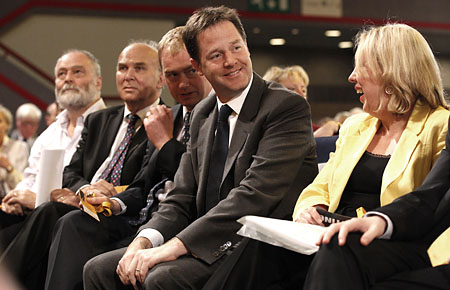
Britain's deputy prime minister Nick Clegg (2nd R) waits a speech from Business Secretary Vince Cable (2nd L) during the Liberal Democrats annual autumn conference in Birmingham, central England, September 19, 2011. (Photo: Darren Staples / Reuters)
There was a moment during Nick Clegg’s Q&A Monday at the annual Liberal Democrat Party conference in Birmingham where a questioner asked if Clegg was feeling “hopeless and embarrassed” to be sharing a government with British Prime Minister David Cameron. The question had to do with a scandal earlier this year over the hiring of interns, and Cameron’s assertion that it wasn’t wrong to favor the children of friends. The surprise wasn’t in the question – indeed, if the British press is to be believed, the Liberal Democrats are at the point of insurrection; they’re so unhappy with Clegg’s power sharing – but in the response. Hundreds of LibDem delegates collectively murmured “No,” or outright booed.
A year ago, a similar question might have been cheered at such a gathering. Emphatic defeats in local elections and the slapping down of the much-discussed Alternative Vote System — long a central plank in the LibDem platform — in a referendum hardly helped the mood. But what a difference a year makes. As Clegg and Cameron grapple the first coalition government in 70 years, Liberal Democrat unhappiness with power sharing – indeed with governing as a whole – seems to have found its ceiling and is slowly coming down. “I’ve heard a lot of complaints from local supporters,” says Therese Evans, a Liberal Democrat on Winchester City Council. “But [Clegg] is quite right, we had to do what we did, we have no other choices, and he said exactly what I can take back to [LibDem voters] and tell them.”
(SEE: Top 10 moments from the 2010 U.K. general election.)
Clegg was unapologetic about the path he has led his party down. “Last year we had to show people that coalition government was possible,” he told the audience. “Remember those stories in the last weeks before the election. If there’s a hung Parliament locusts will descend from the heavens, your mortgage will go up… Ludicrous.” At the same time, he acknowledged that now that they are settling down to the business of governing, the time has come to be “more meticulous” in defining the differences between Liberal Democrats and Conservatives. Clegg was careful to note his most recent lines in the sand: on keeping the 50p tax, aid to poor students through the Pupil Premiere program, pushing for Britain to invest 0.7% of its annual budget in international development (including a 350 million pound program to help poor girls in developing nations that he announced Monday during his speech), fair economic reforms, human rights and green investment.
But the buzz at the conference on Monday was about a spate of stories lately about how LibDems – to the anger and dismay of some Conservatives – have achieved 75% of their agenda while Conservatives have only gotten through 60% of their platform. Conservative Home, a political blog, has a pretty good “concession-o-meter” detailing Liberal Democrat victories. When asked about this startling statistic in Birmingham on Monday, Clegg demurred, “I don’t think any fair minded person could say anything other than [that we] punch well above our weight.”
And, even more surprising, Liberal Democrats — who until finding themselves in government have enjoyed the freedom to express virtuous sentiments without having to test their principles by exercising power — seem to like Clegg for his achievements. All six of the random delegates I pulled aside on their way out of Clegg’s speech were nothing but effusive in their praise of him. “Last year wasn’t unhappiness with Nick, it was dislike of the fact that we had to do it – we had to form a coalition,” says Ann McTegart, a councilmember from Vauxhall in London. “It’s taken us a long time to realize that there aren’t just two views – left and right. And if you keep kicking one or the other out they spend all their time undoing their predecessors’ work. What’s nice about the coalition is it doesn’t move left or right – only forward.”
Clegg is hoping to build on this feeling of empowerment – nay, of responsibility. “We’ve got to convince voters in the future that we can be trusted with governing,” he told the crowd. “We’ve got to look ahead, not backwards.” In other words, Liberal Democrats, the sky isn’t falling – in fact quite the opposite might be true – just because the party’s in power.