


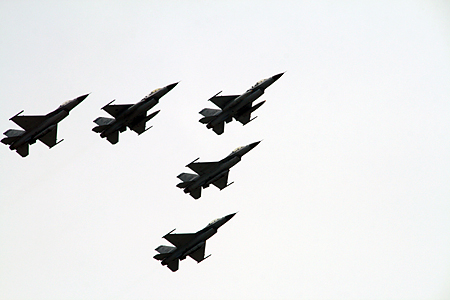
Five F-16A/B warplanes fly over the Sungshan Air Force Base in Taipei, Taiwan, in an airshow on August 13, 2011. (Photo: David Chang / EPA)
U.S. presidents have reason to not relish decisions on selling arms to Taiwan. Say yes, as Barack Obama did in January 2010, when he approved the sale of $6.4 billion worth of equipment including Patriot air defense missiles, Black Hawk helicopters and two Osprey mine-hunting ships, and you anger China. China considers Taiwan to be part of its territory that must eventually be reunited with the mainland, by force if necessary. The Beijing government considers the arms sales, which are authorized under the 1979 Taiwan Relations Act, to be acts of interference in its own internal affairs. After the 2010 arms sale, China cut off military ties with the U.S., only resuming them in late 2010 ahead of President Hu Jintao’s state visit to Washington.
Say no—President Obama’s expected answer to a request from Taiwan for advanced F-16 fighter jets—and you anger many in Congress who say the decision sells out a small, young democracy that is threatened by the increasing military might of China, which lies just 100 miles away across the Taiwan Strait. In addition, building the 66 F-16 C/D fighters requested by Taiwan would support thousands of American jobs, say Senators John Cornyn (R-Texas) and Robert Menendez (D-New Jersey). The pair have introduced legislation that would require the U.S. to sell the aircraft to Taiwan. (The F-16 is built in Texas by Lockheed Martin, and its construction also supports 750 jobs in New Jersey, according to Menendez.)
Taiwan’s current fleet includes an earlier version of the aircraft, the F-16 A/B. President George H.W. Bush approve the sale of 150 F-16 A/B to Taiwan in 1992, when the balance of power in the region was far different. Taiwan’s fighting forces, despite their vastly smaller size, were then considered more advanced, and any attempt by China to invade was derided by military analysts as a “million-man swim.” When China fired rockets over the Taiwan Strait in 1995 and 1996 to protest the policies and election campaign of President Lee Teng-hui, the U.S. sent two aircraft carrier groups to the region as a show of force.
(SEE: Pictures of the making of modern China.)
In the 15 years since that standoff, China has emerged as both an economic and military force. It is the world’s second-largest economy, the largest foreign holder of U.S. debt, and it has been boosting military spending by double-digit percentages for most of the past decade. The People’s Liberation Army is still not a direct rival to the U.S. military, which has a budget six times larger, but China is developing anti-access weaponry, such as a “carrier killer” missile that could threaten U.S. vessels in the region. While the likelihood of direct military conflict between the U.S. and China is low, China’s military modernization would make a decision to send a U.S. aircraft carrier to support Taiwan in a crisis far more complicated.
The Pentagon’s latest annual report on the Chinese military mentioned this shifting balance, noting that “Taiwan’s relatively modest defense spending has failed to keep pace with ambitious military developments on the mainland.” Backers of the F-16 sale have pointed to that analysis as further proof that Obama should approve a deal. But reports out of Washington (see the Washington Times, New York Times and Washington Post) indicate the administration will instead offer a package of upgrades to Taiwan’s older F-16s.
That plan will likely anger both China, as it still involves providing military assistance to Taiwan, and those in Taiwan and the U.S. Congress who were seeking a sale of the advanced jets. When Taiwan first requested the jets in 2006, then-President George W. Bush delayed making a decision and left it to his predecessor to handle. It isn’t hard to see why.
Austin Ramzy is Beijing correspondent for TIME. Find him on Twitter at @austinramzy. You can also continue the discussion on TIME’s Facebook page and on Twitter at @TIME.