


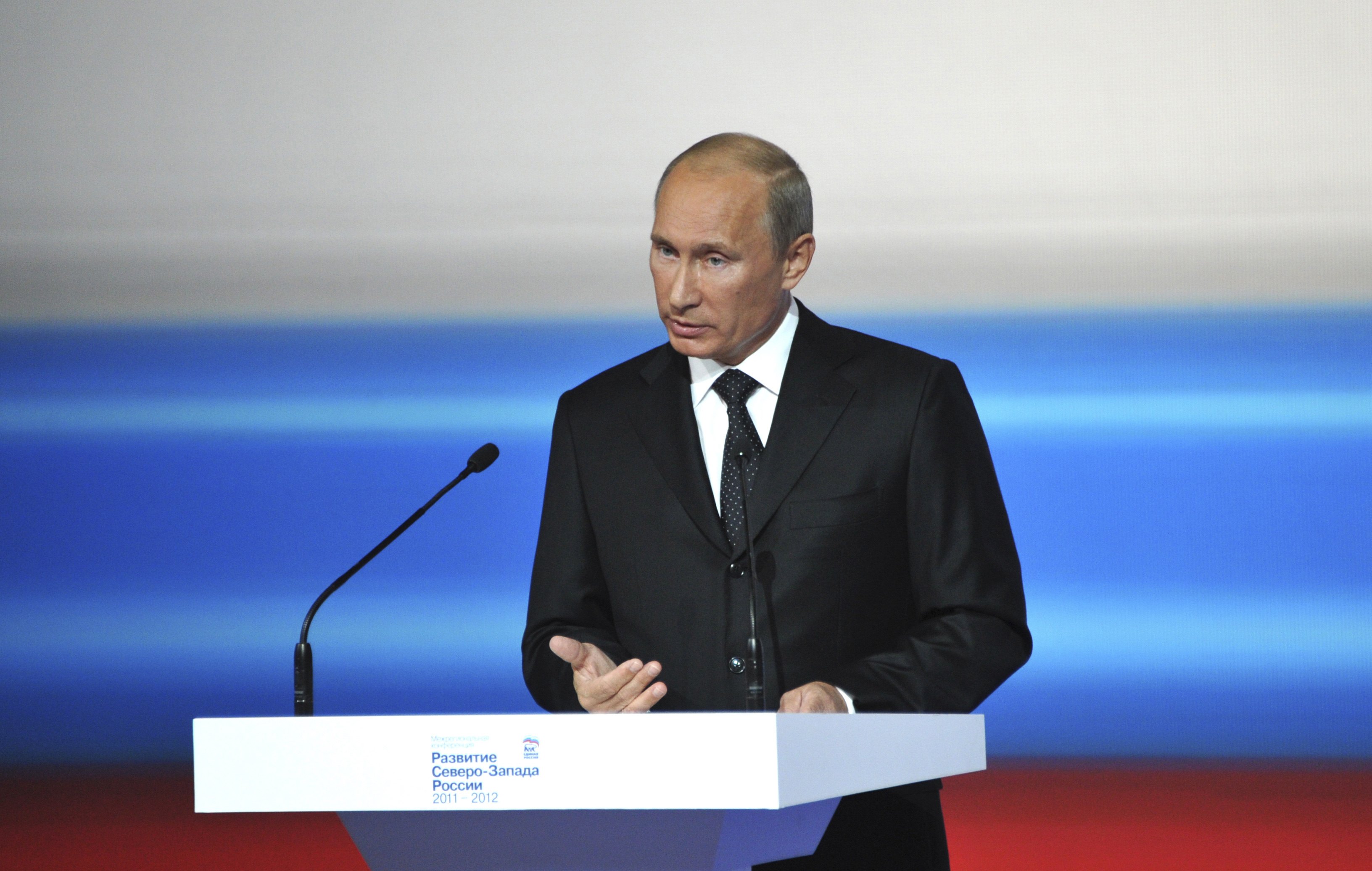
Russia's Prime Minister Vladimir Putin speaks during a regional conference of his United Russia party in Cherepovets, Russia, September 5, 2011. (Photo: Alexei Nikolsky / RIA / Reuters)
Last year, a day before the imprisoned Chinese writer Liu Xiaobo was awarded the Nobel Peace Prize in absentia in Norway, a group of Chinese scholars with ties to the Chinese Culture Ministry announced the victor in the inaugural Confucius Peace Prize. According to the 100,000-yuan (around $16,130 at today’s exchange rate) award’s curious announcement, the Chinese award was created because “China is a symbol of peace…it owns the absolute power to uphold peace…Norway is only a small country with scarce land area and population…it must be in the minority…concerning the conception of freedom and democracy.” Subtle the Confucius Prize was not.
Last year’s winner, Taiwan’s former Vice President Lien Chan, who bettered relations between mainland China and his home island, failed to show up at the Beijing award ceremony. In fact, he had no idea he had won until the press contacted him the day before. To avoid embarrassment, the prize was handed to a solemn little girl who was officially dubbed an “angel of peace.” China-watchers might have been excused for thinking this crude attempt to promote an alternative peace prize would quietly wither.
But over the past weekend, a Beijing juror released the list of nominees for the second annual Confucius Peace Prize. This year’s contenders for their efforts to promote peace—drum roll, please—include Russia’s Prime Minister Vladimir Putin and a Tibetan named Gyaltsen Norbu, who was controversially chosen by Beijing as a senior Buddhist cleric. (Norbu’s young rival for the Panchen Lama position—who was chosen by the exiled Dalai Lama, another Nobel Peace Prize Laureate detested by Beijing—has been missing for years.) This year’s list also included German Chancellor Angela Merkel, who was cautioned by the juror to “pay attention to Eastern values”; South African President Jacob Zuma; computer guru and philanthropist Bill Gates; retired UN Secretary General Kofi Annan; and Chinese researcher Yuan Longping, who developed hybrid rice. (In the award’s first incarnation, Lien beat out Nelson Mandela, Mahmoud Abbas, Gates and the same Beijing-sanctioned Panchen Lama, among others.)
Fans of the Confucius prize will have to wait until Dec. 9 for the ceremony lauding this year’s new winner. And, yes, that would be a day before the Nobel Peace Prize is awarded. For an honor named after the ancient Chinese philosopher sometimes known as the “timely sage,” the timing couldn’t be any more telling.