


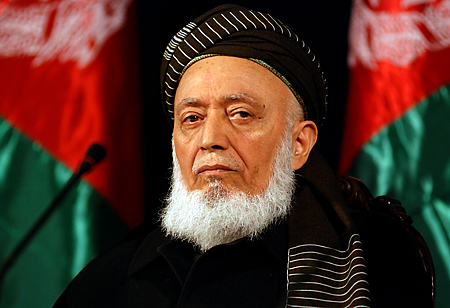
Burhanuddin Rabbani, former Afghan president and head of the High Peace Council, speaks to delegates during the joint gathering of the High Peace Council and the Ulema Council, in Kabul, Afghanistan on March 1, 2011. (Photo: Pajhwok Afghan News / Corbis)
In Afghanistan, the turban transcends tribe. It is worn by all ethnic groups, from the Tajiks and Uzbeks that dominate the north, to the Pashtuns who reside in the south. The Taliban wear turbans, but so do the tribal militias fighting them. Though out of fashion among the young and urban, it is still the symbol of a man’s honor and stature in society. To give one’s turban as a gift is a profound symbol of kinship and loyalty. Today, with the assassination of former Afghan President Burhanuddin Rabbani by a suicide bomber who concealed his explosives in a turban, that symbol of peace has been subverted into a declaration of war.
Rabbani was head of Afghanistan’s High Peace Council, a body made up of influential Afghans from all sides of the political spectrum, tasked with seeking peace with the Taliban. The group had made little headway during its near year long existence—if anything, a series of similar high profile assassinations over the past few months indicates that the Taliban are not interested in any kind of reconciliation—but still, Rabbani persevered. Out of hope, perhaps, but also a recognition that with the 2014 deadline for the withdrawal of foreign and U.S. forces looming, Afghanistan has little option for peace other than some kind of political accommodation with the leaders of the ongoing insurgency.
(SEE: Photos of last week’s audacious attacks in Kabul.)
The man who killed Rabbani was a trusted emissary from the Taliban, according to High Peace Council member Fazel Karim Aymaq. Two men had arrived at Rabbani’s house with “special messages” from the Taliban, Aymaq told AFP, and were “very trusted.” While they may have been patted down upon arrival, it is unlikely that they would have been asked to remove their turbans – to do so would have been a serious affront. When they were shown into Rabbani’s salon, Aymaq said, “one of them put his head on the shoulder of Rabbani and detonated the explosives hidden in his turban.” The bomber died, and his companion has been taken to the hospital with serious wounds. Rabbani died at the scene.
Rabbani’s quiet voice, white beard and grandfatherly demeanor belied a man of fierce will and canny intellect. Once the head of a major jihadi militia during the anti-Soviet jihad, he eventually became president after the death of his communist-backed predecessor in 1992. As an ethnic Tajik from Badakshan, however, his power over Pashtun-dominated Afghanistan was always in question. His time in power was marked by a bloody civil war that ended when the Taliban took Kabul in 1996. He, along with several other militia leaders, retreated north, only to reemerge in 2001 as nominal head of the newly reconstituted anti-Taliban Northern Alliance.
Like many other warlords from the civil war era, Rabbani has been implicated in major human rights abuses by Afghan rights groups. But he shed his warlord reputation early on, joining Afghanistan’s political scene, and becoming a kind of eminence grise of Afghan politics. In 2009 he contemplated a run for the Presidency, telling TIME that he was disappointed by President Hamid Karzai’s performance. “Every year the problems are getting worse, security is deteriorating, corruption is getting worse and national trust in government is being lost. I see the roots of these problems in the weakness and incapability of the government.”
Even then, members of his new political group, drawn largely from the old Northern Alliance, spoke of arming themselves against the perceived threat of a Taliban return. That Rabbani eventually went on to head the High Peace Council at Karzai’s request speaks not only of his political malleability, but also, perhaps, a recognition that only someone of his stature could ensure Northern Alliance support for the reconciliation process.
His death puts those tenuous gains into question and lays the groundwork for civil war once the foreign forces leave. Several of the old Northern Alliance commanders have reemerged, consolidating their militias and stockpiling arms and ammunitions. Allies who have long feared that Karzai, an ethnic Pashtun, was getting too close to the Taliban may now see those concerns vindicated. Even Rabbani knew that the chances for a lasting peace in Afghanistan were slim. Though the Taliban have yet to take responsibility, Rabbani’s assassination by a supposed peace envoy makes it clear that they don’t see a future in reconciliation either.
Aryn Baker is TIME’s Middle East Bureau Chief, based in Beirut. Find her on Twitter at @arynebaker. You can also continue the discussion on TIME’s Facebook page and on Twitter at @TIMEWorld.