


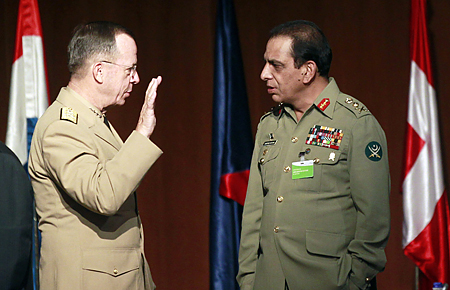
Pakistan's Army Chief General Ashfaq Kayani (R) listens to U.S. Admiral Mike Mullen at the start of the NATO MC conference in Seville September 16, 2011. (Photo: Javier Diaz / Reuters)
Last week’s Taliban assault on the U.S. embassy and other prominent ministerial buildings in Kabul brought into relief once more the brazen conviction of militants in war-blighted Afghanistan as well as their considerable tactical capabilities in pulling off the raid. U.S. diplomats quickly pointed the finger at the al-Qaeda-linked Haqqani network, which is thought to be based in North Waziristan, in the rugged badlands of the Pakistan-Afghanistan frontier. But, in another clear jab at Islamabad, Obama Administration officials have gone on record complaining of Pakistan’s continued tacit support of militancy in the region, in particular the Haqqani network.
At a speech delivered to the Carnegie Endowment for International Peace on Tuesday, Adm. Mike Mullen, chairman of the Joint Chiefs of Staff, spoke of a lengthy conversation he had with his Pakistani counterpart, Gen. Ashfaq Kayani, about the need for Pakistan’s controversial military intelligence agency, the ISI, to sever its ties with the Haqqanis and other militants.
We covered … the need for the Haqqani Network to disengage, specifically the need for the ISI to disconnect from Haqqani and from this proxy war that they’re fighting. The ISI has been doing this – working for – supporting proxies for an extended period of time. It is a strategy in the country and I think that strategic approach has to shift in the future.
When have we heard that before?
The ISI’s chief, Gen. Ahmed Shuja Pasha, incidentally was in Washington today, sitting down with his new CIA counterpart Gen. David Petraeus. Similar, perhaps more bluntly-worded messages were likely put forth. But there’s little reason to believe that such ultimatums will shake-up the status quo. On the sidelines of last year’s U.N. General Assembly powwow, TIME met then Pakistani Foreign Minister Shah Mahmood Qureshi, who insisted at the time that both the (relatively weak) civilian government and the decidedly more influential Pakistani military were on the same page when it came tackling the terrorists and Islamist militants in their midst — insurgents who have unleashed more death and mayhem in Pakistan than anywhere else.
Yet, conspicuously, some factions have continued to operate with relative impunity: in particular, Lashkar-e-Taiba, which directs its animus toward Pakistan’s archrival, India, and the Haqqani network, which, from its seat in Pakistan’s tribal agencies, has carried out some of the more sophisticated militant operations in Afghanistan. For decades now, various elements of the Pakistani military have maintained relationships with these groups out of ideological empathy and tactical expedience. Hemmed on either side by governments that traditionally don’t have the closest of ties with the Pakistanis, the militant groups provide Islamabad what observers deem “strategic depth” — or so it goes in wonk parlance.
The Pakistanis were quick to dismiss these ties, but the discovery of Osama bin Laden’s hideout in leafy Abbottabad put the military, in particular, on the defensive. A summer of acrimony and deteriorating relations with the U.S. followed. The Washington Post reports that now many senior American officials are at the end of their tether:
In what amounts to an ultimatum, administration officials have indicated that the United States will act unilaterally if Pakistan does not comply. The message, delivered in high-level meetings and public statements over the past several days, reflects the belief of a growing number of senior administration officials that a years-long strategy of using persuasion and military assistance to influence Pakistani behavior has been ineffective.
But it’s unclear whether this level of coercion will change the facts on the ground. Years of dutifully propping up the Pakistani military hasn’t got Washington very far, but nor have recent months of diplomatic brow-beating.