


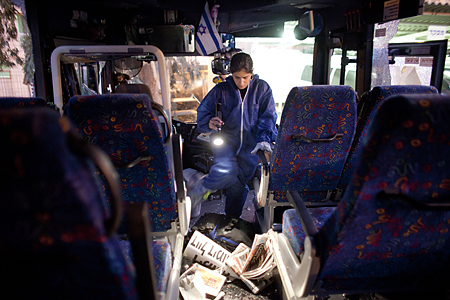
An Israeli police forensic officer inspects Bus 392 inside a police station following an attack, on August 18, 2011 in Eilat, Israel. (Photo: Uriel Sinai / Getty Images)
Comes now a report in the Israeli press that purports to solve the mystery stubbornly trailing the unusual Aug. 18 terror attack on a desert highway in the far south of Israel — but the answer suggests even deeper problems for Israel: Though Israel bombed the Gaza Strip in retaliation for the attack that left eight Israelis dead, an investigation by the Israel Defense Forces determined that all of those who actually participated in the attack were Egyptians, according to the daily Yedioth Ahronoth.
“The IDF’s investigation of the incident was recently completed and its findings indicate that the Popular Resistance Committees in Gaza sponsored the terror attack, but the terrorists who executed the attack were Egyptians,” reporter Alex Fishman wrote. “The Egyptian terrorists were responsible for the sniper fire from within Egyptian territory, and the three squads of suicide bombers who went onto Route 12 to attack the Israeli vehicles were also comprised of Egyptian citizens.” Fishman reports that the operational cell numbered 20 people, including the Palestinian handlers. One, the story says, was an Egyptian police officer on active duty.
The findings would explain to the mystified residents of Gaza the utter absence of either the mourning or celebration that routinely occurs in the Palestinian enclave after a successful terror attack against Israel, which pulled out of the strip in 2005 but still keeps a tight clamp on its boundaries. In the days and weeks after the complex, multi-layered attack near the Israeli resort city of Eilat, no young militants from Gaza were said to be missing after the attack, and no funeral tents went up at the homes of families for neighbors to pay their respects for the loss of a “martyr.” Gazans did not know what to make of it, especially when the Popular Committees, a militant group that ranks third in size behind Hamas and Islamic Jihad in Gaza, insisted it was not in fact responsible — although a spokesman for the group also acknowledged to TIME that Gaza militants have been warned by Egyptian authorities (whom they want to cultivate) not to carry out attacks from their territory.
The Yedioth report also jibes with the eyewitness report of an Israeli motorist who survived the ambush and later described watching as a man in an Egyptian military uniform walked across the border into Israel, lay down and opened fire. The attack began at midday and continued til after dark, when a sniper killed an Israeli SWAT officer. When the Israelis returned fire, five Egyptian police officers were killed, setting off a diplomatic crisis that nearly resulted in Cairo recalling its ambassador from Tel Aviv. He remained, but the Israeli ambassador to Cairo fled weeks later when an Egyptian mob overran the embassy.
The IDF’s report on the nationality of the attackers will do little to calm tensions between the neighbors, which fought four wars before signing a peace treaty in 1979. Fishman reports that Egyptian authorities were informed of the Israeli findings but rejected them and apparently only wanted to talk about Israeli responsibility for the deaths of the five police.