


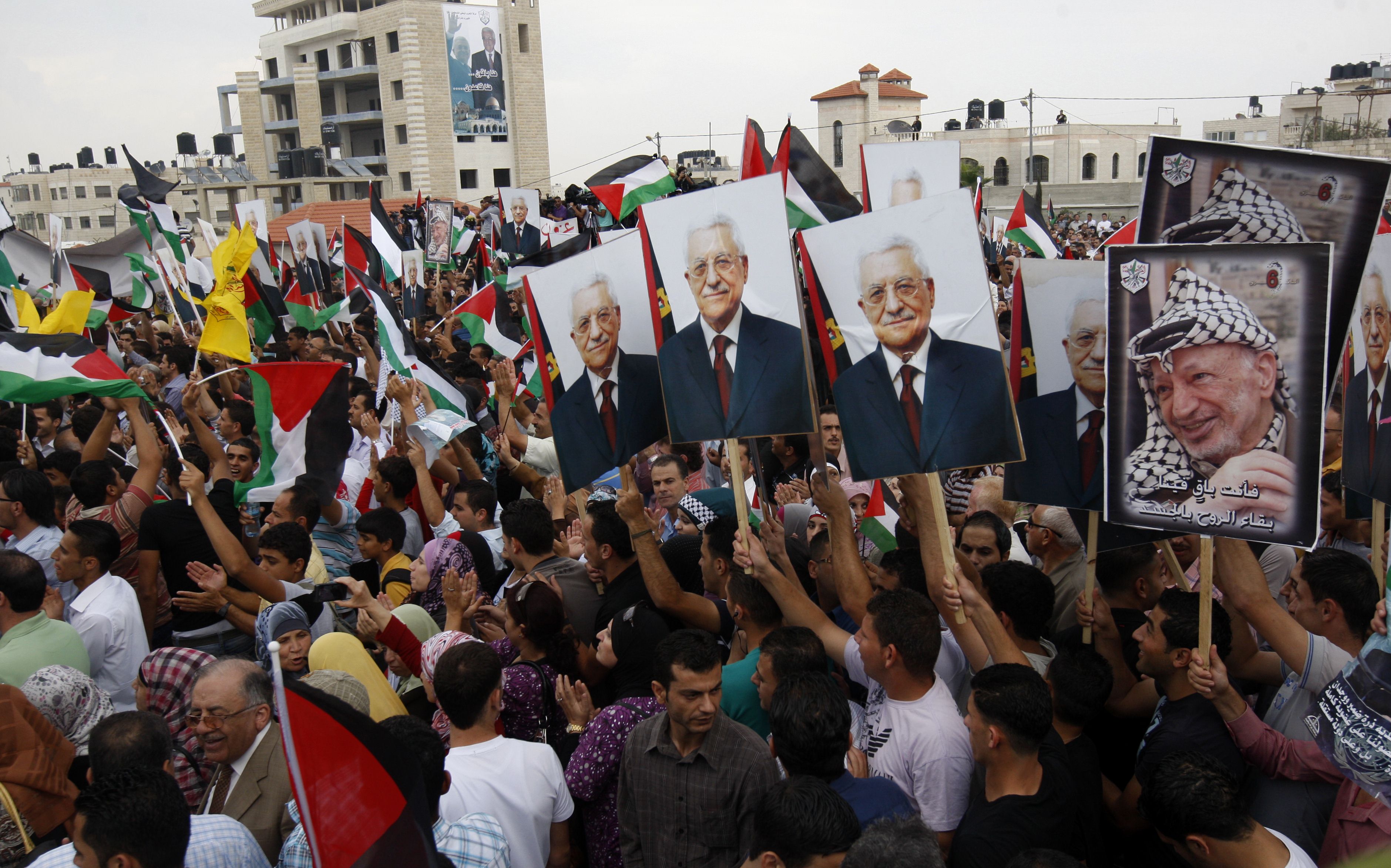
Thousands of cheering Palestinians welcome their president Mahmud Abbas (poster) outside his Ramallah headquarters on September 25, 2011, as he returned from delivering a historic UN membership bid. (Photo: Ahmad Gharabli / AFP / Getty Images)
The man who lives in Yasser Arafat’s shadow returned from New York to a reception that suggested a measure of newfound respect from a Palestinian public that likes its leaders to show some steel.
Abu Mazen, as Palestinian Authority President Mahmoud Abbas is known here, always had the respect of the population that elected him in 2005, and let him stay on when his formal term expired. But that’s the least to be expected of a leader in what is supposed to be a national liberation movement. “He’s a nice guy,” says Imriyad Farah, 72, measuring out faint praise as she made her way to the walled presidential complex where thousands were gathering. “Everybody likes him. He never hurt anybody.”
Though a regular at rallies, the grandmother insists she is not a member of Fatah, the secular faction that controls the West Bank, and can be relied upon to put several thousand people into the street at a moment’s notice. On Sunday, government offices and schools closed early in order to assure a healthy turnout. And the overwhelming majority of the chanting, singing and applauding were party faithful. But not all.
“No, I’m independent,” says Ihussein Abed il-Haq, standing on the fringe of the crowd, beneath a giant poster of Abbas at the UN lectern holding the application for statehood overhead as the General Assembly cheered. His speech Friday “thrilled” il-Haq, who honestly did not think Abbas would proceed with the bid for full membership, especially after President Obama’s strikingly pro-Israel remarks on the same podium two days earlier.
“He had a lot of guts,” he says, making a fist. “It wasn’t something I expected him to do.”
And so the fifty-year-old engineer was stirred to take the afternoon off from work and pay 30 shekels ($8) to ride the bus from Nablus with a the coworker standing beside him. “We’re happy because the world has heard our voice,” Abed il-Bassit Dweikat says.
Il-Haq did not vote for Abbas. With a smile, he says, “I chose the people who have the best reputation among the people,” a sidelong way of saying Hamas, whose piety and community work served it well in the electoral contest against Fatah, which is widely seen as corrupt. But Hamas, which governs the 1.5 million Palestinians in the Gaza Strip, may be regretting its hesitation to support Abbas’ UN strategy. “The situation has changed,” Il-Haq says. “Not 100 percent, but obviously there were people who did not support Abu Mazen and after this they will.”
What impressed Palestinians most, they say, was the defiant tone of the speech. Abbas ran for office, with strong U.S. support, as a man of peace; he is famously uncomfortable in crowds and lives to negotiate. But in the UN speech il-Haq detected none of what he calls “the diplomacy” that tended to soften even lists of Israel’s transgressions in Abbas’ remarks. “Enough! Enough! Enough!” he said in New York, to applause from a packed auditorium.
“The words he spoke made us all feel that we’re for the same cause,” il-Haq says, as a phalanx of young Fatah activists march by with photos of the president: a nice man in a suit and glasses. Never mind that, before he left for New York, critics warned that the membership bid was only a matter of paperwork, one that might improve Palestinian position in later negotiations with Israel but that risked agitating Palestinians in the near term, because it would change nothing on the ground. Indeed, when he finally spoke in Ramallah, Abbas warned of “many obstacles” ahead, alluding to a threatened cutoff in U.S. aid that now runs to half a billion dollars a year. The people cheered that, too.
“Nothing on the ground has changed,” il-Haq says, “except that people want to express how happy they are with what he’s done.”