


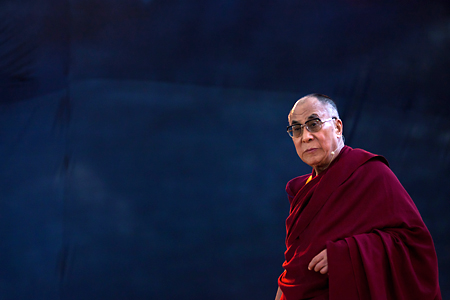
Tibet's exiled spiritual leader Tenzin Gyatso, the 14th Dalai Lama attends an open public talk at the Pavilion of Anhembi in Sao Paulo, Brazil, on September 17, 2011. (Photo: Yasuyoshi Chiba / AFP / Getty Images)
All will be clear when the Dalai Lama is around 90 years old. That was the message from the exiled Tibetan spiritual leader over the weekend, as he convened a conference of various Tibetan Buddhist sects in the Indian hill station of Dharamsala. Although the Nobel Peace Prize laureate, 76, is in good health, the issue of what will happen to the Tibetan struggle once he dies looms in many minds. Tibetans believe that he will be reincarnated; after all, the current Dalai Lama is considered the 14th incarnation of the Tibetan god of compassion. But how—and if—this will happen will only be revealed in “clear written instructions” that the Tibetan leader promises to release when he reaches his ninth decade.
Since fleeing Tibet in 1959 following the invasion of Chinese communist troops earlier in the decade, the Dalai Lama has raised the profile of his flock above any number of little-known oppressed peoples. Indeed, he is far more famous worldwide than any living Chinese ruler. No wonder many Tibetans worry that their campaign for meaningful autonomy from the Chinese will wane when their beloved leader dies.
Chinese government officials appear to believe the same. From Beijing’s perspective, the best scenario unfolds like this: the Dalai Lama dies, the Tibetan movement is robbed of its charismatic leader and Tibet becomes just another of the hundreds of obscure ethnic struggles that litters the globe. But just to ensure China’s control over Tibet—which the Tibetans feel was essentially independent when the Chinese marched in starting in 1950 and the Chinese believe was an integral part of their territory for centuries—Beijing has reiterated that it has the right to pick the 15th Dalai Lama. China claims historical precedent on the matter, contending that emperors who ruled over China long ago performed that very task.
(More on TIME.com: Read an interview with the Dalai Lama’s successor)
The Dalai Lama, in his public statement released on Sept. 24, struck back: “Today, the authoritarian rulers of the People’s Republic of China, who as communists reject religion…still involve themselves in religious affairs… It is particularly inappropriate for Chinese communists, who explicitly reject even the idea of past and future lives, let alone the concept of reincarnate Tulkus [high-ranking Tibetan Buddhist clerics], to meddle in the system of reincarnation…Such brazen meddling contradicts their own political ideology and reveals their double standards.”
There is already a disturbing precedent of divisions between Beijing and the exile Tibetan community that has coalesced in Dharamsala. In 1989, the Panchen Lama, the second-highest-ranking Tibetan cleric after the Dalai Lama, died suddenly. In 1995, the Dalai Lama named his selection for the Panchen Lama’s reincarnation. Beijing countered with its choice. The Dalai Lama’s pick, a six-year-old boy, has since disappeared from view. The Dalai Lama’s promise of clear succession guidelines when he is around 90 years old is no doubt designed to avoid a situation similar to the Panchen Lama’s—although there is almost no way that Beijing will give him any heed.
In the Dalai Lama’s Sept. 24 statement, he raised various intriguing possibilities. One was that his reincarnation could be picked before he died, something he said has historical precedent with the case of other Tibetan lamas. Another was that the line would actually end with him, meaning there would be no 15th Dalai Lama. Even in the case of a standard reincarnation, the Dalai Lama stressed that his trust would pick his successor and that China should bear no part in the decision-making process: “Bear in mind that, apart from the reincarnation recognized through such legitimate methods, no recognition or acceptance should be given to a candidate chosen for political ends by anyone, including those in the People’s Republic of China.”
On Monday, Chinese Foreign Ministry spokesman Hong Lei dismissed the Dalai Lama’s succession statement, saying: “I would like to point out the title of the Dalai Lama is conferred by the central government and is otherwise illegal.” The two sides are at an impasse. Years of intermittent dialogue between Chinese officials and representatives of the current Dalai Lama have achieved nothing. Beijing’s crackdown on Tibet following a spate of unrest in 2008 continues, as do sporadic expressions of dissent. On Monday, two Tibetan monks set themselves on fire in an ethnically Tibetan part of China’s Sichuan province, according to a Tibetan exile group, at least the fourth such self-immolation by a Tibetan cleric this year. Despite six decades of Chinese rule, Tibetans seem no closer to accepting Beijing’s authority. It’s unlikely that the 14 years until the Dalai Lama turns 90 will change that.