


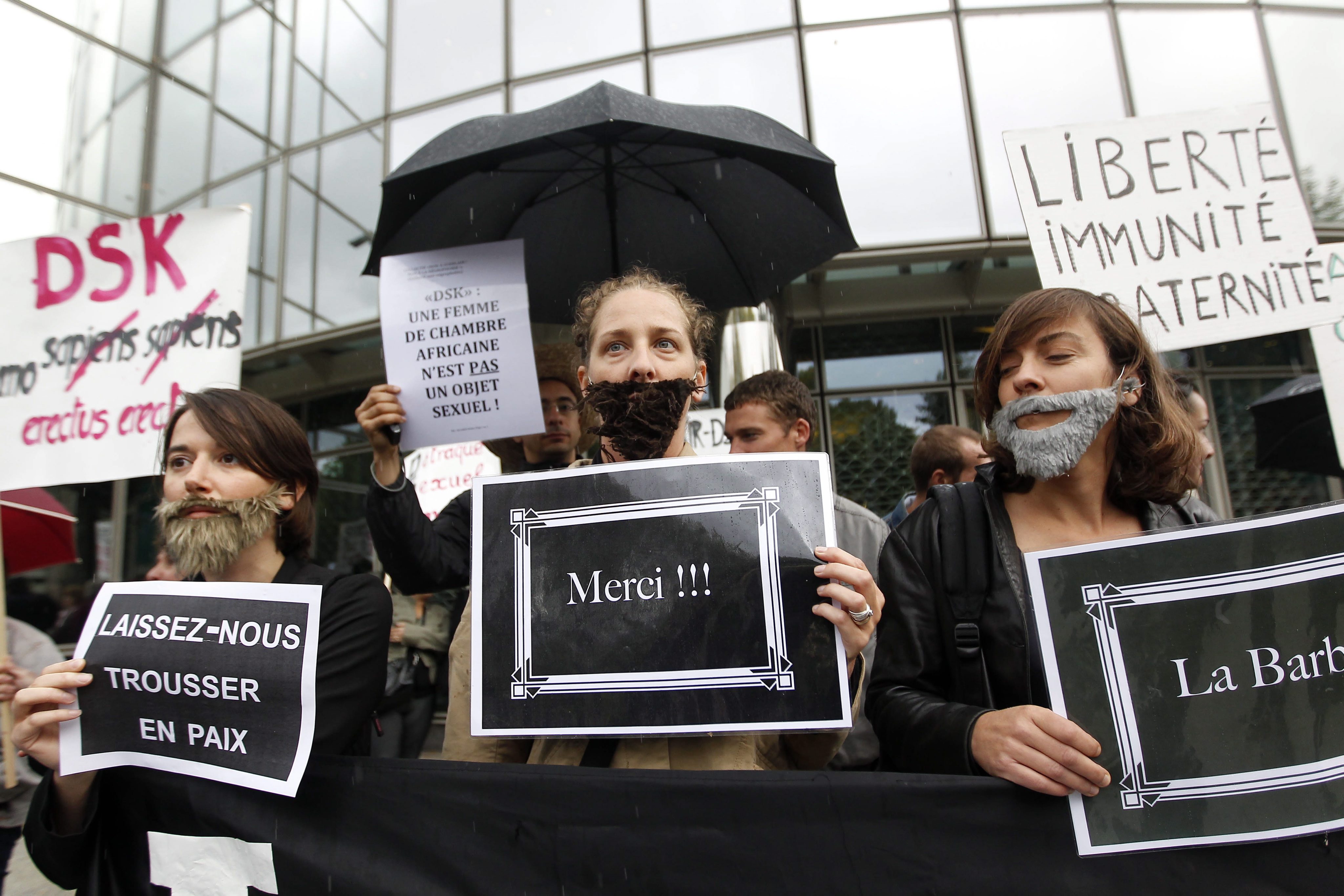
Members of feminist protest group 'La Barbe' (The Beard) demonstrate outside the French television TF1 studios, in Paris, France, September 18, 2011, where former International Monetary Fund leader Dominique Strauss-Kahn made his first public television appearancein an interview during the 8 o'clock evening news. (Photo: Ian Langsdon / EPA)
Though it isn’t a direct result of the gender debate that arose from the attempted rape charges lodged against Dominique Strauss-Kahn, a new campaign by French feminists does indicate they’re more determined than ever to remedy the habitual injustices France’s male-dominated society imposes upon them. As part of that, an offensive is now underway to blot out the word “mademoiselle” —or “Miss”—that detractors say publicly brands women as unwed (and possibly unwanted) in a public manner French men are spared. To that end–over four decades after American feminists demanded to be called “Ms.”, and 39 years after Germany’s 1972 decision to strike “Fraulein” from official use–French feminists want “mademoiselle” deposited on the ash heap of sexist history to make way for “madame” as women’s generic answer the male “monsieur”.
On Tuesday, a pair of feminist groups rolled out their campaign to drop “mademoiselle” as one of France’s three standard honorifics alongside “monsieur” et “madame”—a phase-out they want started on state and company forms, and quickly extended to all walks of life. The reason for the move, sociologists, writers, philosophers, and everyday women backing the collective manifesto say, is the term is “sexist and condescending” in publicly identifying unmarried women–and thereby exposing them to an entire range of assumptions or reactions about their unwed status. Public distinction as a “mademoiselle”, detractors say, can incite come-ons from womanizing males clued in to a female’s single status, or inspire other people to mischievously ponder why it might be she hasn’t managed to land a mate yet. Aside from young girls, critics say, “mademoiselle” represents an unwanted, vexing, and invasive label on women that other people interpret at their whim.
“It obliges women to expose their personal or family situation,” protests Julie Muret, a leader of “Osez le Féminisme” (Dare Feminism), one of the two groups behind the movement. She and other backers deride “mademoiselle” as “condescending” to single women vis-à-vis their married peers—and above all before men who aren’t subjected to the same kind of exposure. “It may seem like a detail, but it’s very symbolic of (wider) inequalities,” Muret explains.
How? First off, activists say, use of “mademoiselle” separates women into two categories in a manner men aren’t subjected to. The corresponding honorific for males—“domoiseau”, or roughly “squire”—was dropped from use nearly a century ago, with all men addressed or identified as “monsieur” irrespective of their age or marital status. Use of “mademoiselle” often produces presumptions that a woman is too young or unsettled to be married, or, beyond a certain age—often not even too advanced—can carry something of an old maid stigma. Losing “mademoiselle” for generic use of “madame”, supporters say, will create the same rules on both sides of the gender divide, eliminate any unflattering and inaccurate assumptions, and reduce discriminatory treatment of women resulting from those.
“I’ve been calling myself ‘madame’ for five years now, because ‘mademoiselle’ just doesn’t sound serious if you’re applying for a job or dealing with a bank, and tends to get you treated as though you’re still a teenager,” says Aude, a 29 year-old communications employee who doesn’t want to be identified by her last name any more than she wants to be called “mademoiselle”—or obtain the married status “madame” usually involves. “When you first start using ‘madame’ you freak out a bit knowing you’re suggesting to everyone you’re married when you’re not. That can be uncomfortable, but the reaction is usually worth it—especially with pushy men who would hit on you otherwise. Plus, I guess I’d rather have people think I’m married than figure I’m a young thing on the prowl, or a desperate old lady.”
The current offensive against “mademoiselle” isn’t entirely new. In 1972, France’s Justice Ministry ruled women were not obliged by law to reveal their marital status by checking either “mademoiselle” or “madame” on official forms. And in 1983, France’s Women’s Rights Minister, Yvette Roudy, stigmatized the use and response to “mademoiselle” as “discrimination”. But while women like Aude have been removing “mademoiselle” from their lives when possible over the years, no real gains towards officially dumping the title have been made—perhaps till now.
Debate that flared up about the treatment of French women in the wake of the Strauss-Kahn drama has set the table for even wider efforts by women to level the gender playing field—using the passions unleashed by the DSK affair as their sharpest edge. Initial declarations to Strauss-Kahn’s May 14 arrest by French political leaders (mostly men) and pundits (ditto) defending his innocence and rejecting claims he could have forced himself on a hotel maid as alleged caused disgusted French women to beg to differ. Some did so as they cast accusing gazes across that chorus of male protestors and pointed out that sexual misconduct occurs far more often (and usually with boys-will-be-boys indulgence when men are accused of it) than most people like to admit. Indignant women similarly reacted to subsequent media details about long-whispered—but never published—cases of earlier questionable behavior by Strauss-Kahn as an example of the kind of collective conniving and indifference to sexual aggression French women can suffer, and vowed to battle it now that light has been cast on the problem.
But even before the DSK controversy broke, moves were afoot to address some of the glaring inequalities French women still suffer. Among those were move to raise salaries paid to women that are nearly 1/3 lower than those paid to males for the same jobs, and efforts to crack the glass ceilings in businesses that not only prevent French women from attaining as many top management spots as men, but have kept them all but shut out of corporate boardrooms. Those and other aspects of gender inequality may receive renewed attention as part of the wider dialogue about the state of women in France society provoked by—or at least tied to—the Strauss-Kahn affair.
Indeed, activists now taking aim at “mademoiselle” make a point of saying their effort to erase the term is not so much a reaction to the DSK saga, but rather as part of the wider push to correct discrepancies and imbalances between the sexes. Dissenting feminists have retorted by saying that rather than railing against irritating formalities, effort should be focused on battling the kind of attitudes and abuse that victimize women socially, economically, politically, and physically every day. Campaigners say those two struggles aren’t mutually exclusive, and can nurture one another when fought on separate fronts. Which is why for the time being, “mademoiselle” marks the frontline of the French feminist war for equal treatment.