


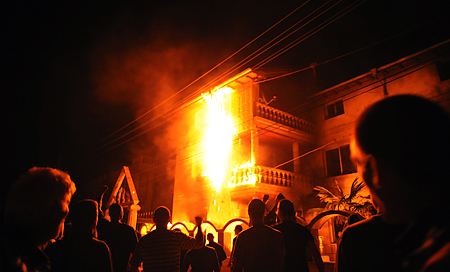
People react outside the house of Roma leader Kiril Rashkov, dubbed "King Kiro", after it was set on fire during a clash between members of the Bulgarian and Roma communities in the village of Katunitsa, some 160 km south-east of Sofia on September 24, 2011. (Photo: NikolayDoychinov / AFP / Getty Images)
The charge that a relative of a Roma clan leader killed a Bulgarian teenager sparked anti-Gypsy demonstrations across the country last weekend. Thousands of protesters took to the streets in at least 20 towns and cities, including the capital, Sofia. “A total of 168 have been arrested for violation of public order, the majority — for possession of small bombs, knives, bats, pipes from vacuum cleaners, kitchen meat hammers,” the Interior Ministry said in a statement Wednesday morning. The Ministry estimates that 2,200 people took part in the second straight night of demonstrations—the worst outbreak of unrest in the country in more than a decade.
Tension began to mount after 19-year old Angel Petrov was run over by a minibus while walking his dog in Katunista, a small town 99 miles east of Sofia. The tragedy might have ended there, were it not for the fact that the driver was allegedly a relative of suspected Roma crime boss Kiril Rashkov. Rashkov, who is known throughout the country as Tzar Kiro, has been under investigation for several years for large-scale tax evasion and has previously been convicted for crimes involving illegal gold transactions. As word spread, locals retaliated by setting a number of Rashkov’s cars and houses on fire.
Police have since arrested the van’s driver, but riots have spread because the incident speaks to the two issues long at the core of Bulgarian discontent: organized crime and the status of the country’s Roma minority (and, in this instance, the potential links between the two). The European Union has repeatedly condemned Bulgaria for failing to prosecute leading organized crime bosses—and the high-level government officials who may be in cahoots with them. That perceived impunity looks all the more stark for young people frustrated with a lack of opportunity during the country’s weak economic recovery.
Deep-seated resentment of the Roma appears to have given the protests much of their momentum. Protesters shouted slogans like “Gypsies into glue!” and police had to barricade the entrances to Roma neighborhoods as word spread of impending riots. As with the riots in London in August, demonstrators and—who counted opportunistic hooligans among their ranks—organized demonstrations partly through Facebook. Others drummed up support via SKAT, a television channel with links to the ultra-nationalist party Ataka, which translates as ‘Attack.’ “The Gypsies have too many rights and no responsibilities,” Angel Katushev, a 22-year-old student at a rally in Sofia told Britain’s Independent. “We pay for them, and we want them to play an active part in social life, paying taxes, following the law and living in a civilized way.”
President Georgi Parvanov knows that addressing those feelings will play a crucial role in diffusing mounting ethnic tension. “The institutions are standing together firm in their opposition to such radical and extreme feelings,” he said. And while Parvanov is hoping for the best, he’s clearly preparing for the worst: the President convened a special meeting of the Consultative Council for National Security for Saturday. Good thing. By Wenesday morning, the Sofia News Agency had published a report in which witnesses claimed the arrested driver is not the actual man behind the Sep. 23 hit-and-run.
(More on Time.com: Read more about anti-Roma sentiment in Europe)
William Lee Adams is a staff writer at the London bureau of TIME. Find him on Twitter at @willyleeadams or on Facebook. You can also continue the discussion on TIME’s Facebook page and on Twitter at @TIME.