


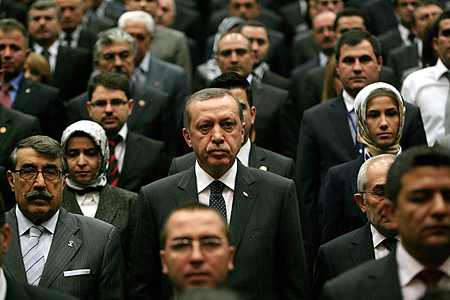
Turkey's Prime Minister Tayyip Erdogan stands among Justice and Development Party (AKP) members during a meeting at the party headquarters in Ankara, September 28, 2011. (Photo: Adem Altan /AFP / Getty Images)
Our interview with Turkish Prime Minister Recep Tayyip Erdogan, published earlier this week on Global Spin, dwelled mostly on the growing shadow cast by the charismatic premier across the face of Mideast geo-politics. One question edited out of the earlier transcript raised the legacy of the Ottoman Empire, whose dominion once stretched over much of the region. As they now swagger through Cairo, Tripoli and other former Ottoman strongholds, Erdogan and — perhaps to even greater degree — his Foreign Minister Ahmet Davutoglu have earned the monicker of “neo-Ottomans.”
Few democratically-elected statesmen in this day and age would welcome the label of imperialists. And, for whatever connotations “neo-Ottomanism” invokes abroad, it’s a far more sensitive subject domestically in Turkey. Nearly a century of Ataturk-inspired, Western-facing secularism meant those raised in modern Turkey looked with wariness upon the decadence, decay and religiosity of Ottoman times, when, after all, Istanbul was the veritable capital of the putative Caliphate.
But much has changed since Erdogan’s rise to power. Turkey no longer pines after Europe — indeed, see Erdogan’s matter-of-fact retort at the close of our interview with him — is ruled by a moderate Islamist party, and has signaled clear intent to influence events in many of the countries once ruled by Ottoman Sultans. Below is Erdogan’s response to a question I posed to him on whether he accepted donning the neo-Ottoman mantle:
Of course we now live in a very different world, which is going through a scary process of transition and change. We were born and raised on the land that is the legacy of the Ottoman empire. They are our ancestors. It is out of the question that we might deny that presence. Of course, the empire had some beautiful parts and some not so beautiful parts. It’s a very natural right for us to use what was beautiful about the Ottoman Empire today. We need to upgrade ourselves in every sense, socially, economically, politically. If we cannot upgrade ourselves and the way we perceive the world, we will lag behind tremendously. It would be self-denial. That’s why whether it be in the Middle East or North Africa or anywhere in the world, our perception has in its core this wealth that is coming from our historical legacy. But it’s established upon principles of peace. And it all depends on people loving one another without discrimination whatsoever.
Critics may wonder how willing Erdogan and other Turkish leaders are to actually admit to the empire’s “not so beautiful parts”, not least the grisly massacre of Armenians when the Ottoman Empire itself was on its last legs. Turkish diplomats on the sidelines of U.N. meetings spoke to TIME of Erdogan’s professed commitment to values of peace, tolerance and neighborly love — a lofty sentiment not exactly on display during the continued Turkish offensive against rebel Kurds in the country’s east.
Still, it’s noteworthy that the Turkish P.M. sees in the Ottoman past a “wealth” — a soft-power cachet, based presumably on the empire’s extraordinary diversity and tolerance of many faiths — to inform the present. We tend to forgive many Western powers, say the French, British and even the Americans, for tracing their foreign policies sometimes in memory (or nostalgia) of lapsed empire. An ascendant, capable Turkey has every right to walk its own post-imperial path as well.