


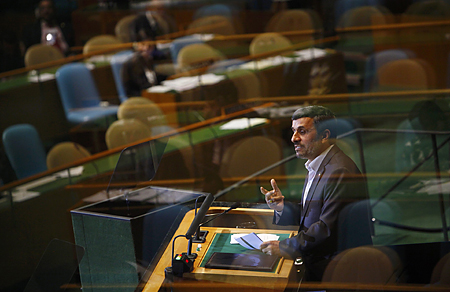
Iran's President Mahmoud Ahmadinejad addresses the United Nations General Assembly as reflections in the glass of a viewing booth show many empty chairs in the chamber after delegates walked out on Ahmadinejad's speech at the U.N. Headquarters in New York, September 22, 2011. (Photo: Eric Thayer / Reuters)
U.S. and other Western diplomats quietly gathered up their papers and walked out of the U.N. General Assembly chamber when Iran’s President Mahmoud Ahmadinejad reiterated his claim that the 9/11 terror attacks were orchestrated by the U.S. itself. But if the diplomats were irked, the remnants of al-Qaeda — at least the chapter in Yemen which produces a bizarre regular glossy magazine written in English and laid out like the airline in-flight rag suggested by its titles, Inspire — was hopping mad. “Why would Iran ascribe to such a ridiculous belief that stands in the face of all logic and evidence?” wrote commentator Abu Suhail in the September edition. The answer, he suggests, is sectarian and cynical — Iran doesn’t want to be upstaged in its claim to lead those standing up to America, and the Shi’ites don’t want to give the Sunni jihadists any credit”
“If Iran was genuine in its animosity towards the U.S., it would be pleased to see another entity striking a blow at the Great Satan but that’s not the case. For Iran, anti-Americanism is merely a game of politics. It is anti-America when it suits it and it is a collaborator with the U.S. when it suits it, as we have seen in the shameful assistance Iran gave to the U.S. in its invasion of Afghanistan and in the Shi`a of Iraq, backed by Iran, bringing the American forces into the country and welcoming them with open arms.”
Al-Qaeda threatened to supplant Iran’s claim to speak on behalf of disenfranchised Muslims, he argued, which is why Iran seeks to undermine al-Qaeda’s 9/11 “achievement” with conspiracy theories.
Hey, just because it’s in a glossy magazine doesn’t mean it has to make sense: First off, the very point about Iran’s “shameful” assistance to the U.S. invasion of Afghanistan highlights the fact that Tehran did not, in fact, subscribe to Ahmadinejad’s conspiratorial drivel about 9/11, and nor does it do so now. Ahmadinejad does not speak for Iran; he speaks largely for himself these days, and ranting about the Holocaust, 9/11 etc. is simply pushing the buttons of the Western media in a desperate attempt to garner attention, having been largely sidelined at home.
More importantly, perhaps, Suhail misses the point that surveys continue to find that an overwhelming majority of public opinion across the Muslim world shares the belief that the 9/11 attacks were not the work of Arabs. Why might this be, when al-Qaeda is jumping up and down insisting it was responsible?
My own suspicion is that this denial of the obvious reflects a generalized abhorrence of directing violence against innocent civilians, which violates Islamic codes of warfare. Even if they agree with al-Qaeda’s view of the West as a predatory, hostile power towards the Muslim world, they are not willing to endorse, much less celebrate violence against innocents in the name of “retaliation”. Al-Qaeda’s real problem is not the antics of Ahmadinejad; it’s the fact that it has been repudiated by the majority of Muslim public opinion, even those sectors who have stood up against U.S.-backed regimes in the Middle East. And that’s a reality that’s not going to be changed by any amount of glossy packaging of al-Qaeda’s discredited ideas.