


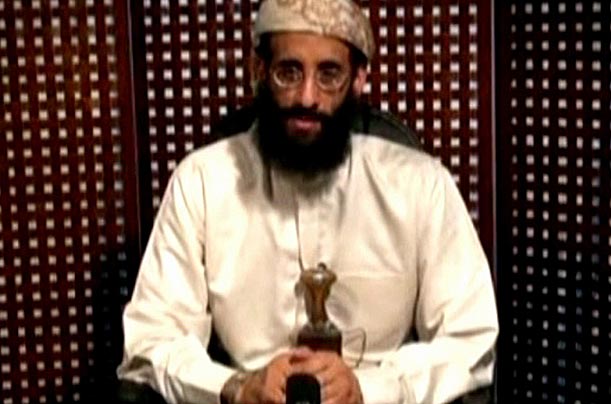
Anwar al-Awlaki in an undated video grab (Photo: Reuters)
U.S. Officials confirmed that Yemeni government news agency reports that Anwar al-Awlaki, the American-born radical cleric has been killed, along with his bodyguards, in a military strike. He was 40-years-old. The English-speaking al Awlaki who is the best known face of al Qaeda in the Arabian Peninsula, is a particularly potent scourge, spewing anti-American rhetoric in long winded diatribes that have a huge online following. Nidal Hassan, the army psychiatrist responsible for the deadly 2009 Fort Hood shootings had printed copies of Awlaki’s sermons among his belongings. And Faisal Shahzad, who failed to detonate a bomb in Times Square said that he had been inspired by Awlaki’s call to wage jihad on America.
Local journalists in Shabwah Province (which is al-Awlaki’s tribal homeland) report that it was an American drone attack on his car. Furthermore, a senior administration official confirmed to Politico that he was killed. And according to the Yemeni government, al-Awlaki was targeted and killed 5 miles (8 kilometers) from the town of Khashef in the Province of al-Jawf. The statement said the operation was launched on Friday at approximately 9:55 a.m. but gave no other details.
(SEE: A photo history of Anwar al-Awlaki in the U.S.)
Cynics will point to the strategic timing – just a week after embattled Yemeni President Ali Abdullah Saleh returned from four months of medial treatment in Saudi Arabia following an attack on the presidential compound. Saleh has been facing intense international pressure to acquiesce to a compromise deal with opposition parties that will see him step down after 33 years in power, in exchange for immunity from prosecution. But so far he has resisted, warning, in an interview with TIME and the Washington Post on Thursday, that the opposition had been taken over by al Qaeda. “What we see is that we are pressurized by America and the international community to speed up the process of handing over power. And we know to where the power is going to go. It is going to Al Qaeda, which is directly and completely linked to the Muslim Brotherhood.”
It’s a claim routinely dismissed by the opposition coalition, which is made up of groups ranging from Islamists to hardened socialists. “It’s pure propaganda,” says Yassin Saeed Noaman, Secretary General of Yemen’s Socialist party and current head of the anti-government coalition. “How else would he describe his enemies if he were trying to get American support?”
Still, many Yemenis fear that the West prioritizes the war on al Qaeda over the struggle for Yemen’s democracy. Awlaki’s death, delivered by Saleh, could be a sign that he is indeed the partner that the Americans need in Yemen. “Guess we are in for another 60 years of Saleh,” one Yemeni quipped, upon hearing the news.
Awlaki’s death has yet to be confirmed, and it’s not clear if he was killed by a Yemeni operation or an American drone attack. A U.S. State Department official and a White House official told CNN that they were aware of breaking news reports but couldn’t confirm he had been killed (they spoke on condition of anonymity because they were not authorized to speak on the record to the media).
Still, the fact that Awlaki was able to give sermons, post slick videos and produce al Qaeda’s signature English-language internet magazine unhindered by security forces raises questions about the government’s true commitment to eradicating al Qaeda in the country. And later Friday afternoon, the government announced that Samir Khan, the garrulous American-born chief propagandist for al-Qaeda’s Inspire magazine, was also killed in the attack. As for Awlaki, his well-timed death, if confirmed, could have been an easy sacrifice for a president under pressure. Though born in New Mexico, he comes from a prominent family, and it’s likely that at least some members of his tribe were well aware of his whereabouts. On the other hand, it’s not the first time that the Yemeni government has trumpeted the death of an al Qaeda leader, only to back down in the face of videotaped evidence to the contrary.