


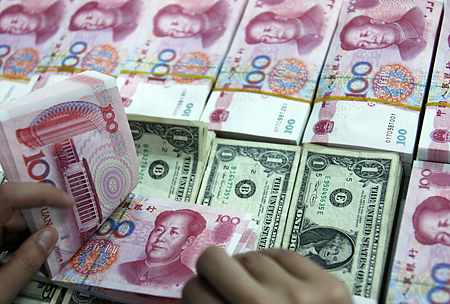
An employee counts money at a branch of Industrial and Commercial Bank of China Limited (ICBC) on July 26, 2011 in Huaibei, China. (Photo: ChinaFotoPress / Getty Images)
Give Charles Schumer credit for persistence. The New York Senator first introduced legislation that targeted Chinese currency in 2003, and has been a leading congressional advocate of the view that China keeps the value of its currency, the renminbi, artificially low, giving its exporters an unfair advantage when competing against U.S. manufacturers. On Monday a bill co-sponsored by Schumer that would allow for duties on goods from countries found to be currency manipulators won a Senate vote to open debate 79-19. If it passes a full Senate vote later this week it faces tougher odds in the House, where Speaker John Boehner has called the legislation “dangerous.” The White House has also so far not said where it stands on the bill.
On Tuesday China’s Foreign Ministry, Ministry of Commerce and central bank all slammed the bill, warning that it could set off a trade war and harm the global economy. Schumer responded Tuesday on the Senate floor by suggesting the Chinese position was a bluff, as a trade war would harm China more than the U.S. “They won’t cut their nose to spite their face,” he said. “They may take a few sanctions in response, but they’re not going to create a trade war.” It is much the same argument Schumer put to me while on a visit to China in March 2005. But in the past five-and-a-half years, a few key numbers have changed. Most significant is U.S. unemployment. In March 2005 the unemployment rate was high at 6.1%, but this August it stood at 9.1%. That added economic misery in the U.S. will add to the political pressure to punish China.
But other figures have changed, too. Since March 2005 the renminbi has appreciated by about 30%. China recognizes that it needs to allow the value of its currency to rise to help encourage domestic consumption, manage inflation and move away from a reliance on cheap exports to create economic growth. But even as the renminbi appreciates, the U.S.-China trade gap has grown from $202 billion in 2005 to $273 billion last year. At the same time China’s global balance of trade has shifted, and this year it became a net importer. Many countries, particularly those that export the energy and raw materials China needs, are benefiting from its continued expansion.
The difficult economic picture in the U.S., combined with the intensified political atmosphere of a presidential campaign will ensure that Schumer’s trade bill gets a much more attention than it would have in years past. At the same time, given the opposition from Boehner and the reluctance of President Obama to endorse the measure, it’s likely that it will be shot down once again. But even if the legislation fails, a stronger Chinese currency is inevitable. How much that will help the American economy remains unanswered.
Austin Ramzy is Beijing correspondent for TIME. Find him on Twitter at @austinramzy. You can also continue the discussion on TIME’s Facebook page and on Twitter at @TIME.