


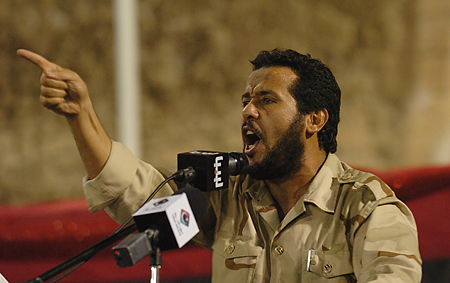
Abdul Belhadj, commander of the Tripoli Military Counci speaks to thousands of Libyans rallying for their revolution in Martyrs' Square September 9, 2011 in Tripoli, Libya. (Photo: Scott Peterson / Getty Images)
When Qatar took a lead in the military campaign to oust Libya’s Colonel Gaddafi, Western officials gushed with praise for the tiny Gulf State punching way above its weight. The nation of just 2 million sent six Mirage fighter jets to lend an all-important Arab presence in the air campaign; it cajoled the Arab League into supporting the military campaign, was among the first to recognize the rebel Transitional National Council as Libya’s government and helped it to sell oil on world markets; armed the rebels and even sent in its own Special Forces to help them capture Tripoli.
But some Western officials appear to be suffering from something of a Qatar hangover, now that the Qataris are judged to be “intervening” in LIbya’s post-Gaddafi politics, by directing funding and support to favored political allies — you know, behaving as the Western powers have traditionally done when they topple a regime in the Middle East. The Guardian reports on a “concern among Libyans in the National Transitional Council (NTC) and western officials that Qatar, which supplied arms to Libyan revolutionaries, is pursuing its own postwar agenda at the cost of wider efforts to bring political stability to the country.”
The substance of their complaint appears to be that Qatar favors the Islamist leader of the Tripoli Military Council, Abdul-Aziz Belhadj, and his ally, the Qatar-based Libyan cleric, Sheikh Ali Salabi. Belhadj and Salabi are fiercely critical of the Western-backed NTC Prime Minister, Mahmoud Jibril, who they accuse of trying to monopolize power and to sideline the Islamists who carried a major part of the military burden of toppling the regime.
But Western pique over Qatar’s involvement in post-Gaddafi politics may simply be a symptom of struggling to come to terms with diminished U.S. influence in a new Mideast geopolitical order, as new players join the regional strategic game with independent agendas that sometimes correspond with those of Washington and at other times conflict with it. While Turkey has established itself as an emerging diplomatic third force between the U.S. and its key regional rivals such as Iran, Qatar has long been carving out a similar role for itself.
Despite its unprecedented military role in Libya, Qatar’s projected power, like Turkey’s, is more typically of the soft variety, as Meghan O’Sullivan noted earlier this week.
As the home and patron of al-Jazeera television, it created the window through which most of the Arab world has viewed and made sense of the wave of democratic protests that swept across the region this year. Not only Arabs, mind you; when the White House wanted to know what was going on the dramatic last days of the Mubarak regime, its television sets were tuned to Jazeera rather than any of the U.S. networks. No surprise there, because it was the one network on which Arabs spoke for themselves and defined their revolution, even if the network’s coverage appears, sometimes, to be guided by Qatar’s own geopolitical choices — it’s shown less enthusiasm, for example, in covering Bahrain’s democratic uprising, whose suppression by a Saudi-led force was backed by Qatar’s leaders.
Qatar is extremely wealthy — its per capita annual income of $88,000 is the world’s highest — and as such has been able to spread its influence through investment, much as China and more recently Turkey have done. And, like Turkey, it has maintained an alliance with the United States — it hosts the headquarters of Central Command, the hub for U.S. military operations throughout the region — at the same time as adopting independent positions that sometimes conflict with Washington’s agenda. It retains friendly ties with Iran, for example, and directly contradicted U.S. strategy through its efforts to broker a unity agreement between the rival Palestinian movements Hamas and Fatah. At the same time, it maintained trade ties with Israel until the Gaza war in early 2009, although it subsequently offered to restore relations if Israel would allow it to send money and materials to help rebuild the Palestinian territory’s infrastructure.
Even as it seeks to burnish its international image by winning the rights to host the world’s biggest sporting even, soccer’s World Cup, in 2022 — and sponsoring Europe’s almost universally loved champions, Barcelona Football Club — Qatar clearly has some strong ideas about how the Middle East ought to work as its old autocratic order begins to collapse. That many of those ideas are very different from Washington’s may also be not all that surprising — remember, that old order was also known as Pax Americana, and most of the region’s key actors today believe that the U.S. way of doing things in the Middle East was dysfunctional and dangerous. That, and, of course, they have their own interests, which aren’t always the same as Washington’s — and see no reason to defer to a downsizing superpower.
Sure, Qatar has favorites in the emerging Libyan political spectrum? Don’t the U.S. or the British and French? And funneling resources to its favorites — well, let’s humbly suggest that Western diplomats may not be so annoyed by that if Doha was backing the same horses as Washington, London and Paris.