


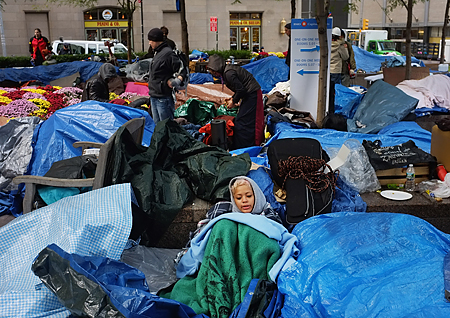
A Wall Street protester wakes up at Zuccotti Park that she and hundreds of other activists are occupying on October 3, 2011 in New York City. (Photo: Spencer Platt / Getty Images)
As the momentum surrounding the Occupy Wall Street protest grows, so too has the urge to frame it in the context of other struggles around the world. Already, Zuccotti Park, the patch of Lower Manhattan taken over for weeks now by the protesters, has been hailed as an American Tahrir Square, a font for a “U.S. autumn” as that plaza in Cairo was for the Arab Spring. Days of action and protest have been dubbed “days of rage,” a gesture to recent, far bloodier episodes of dissent on the streets of Syria, Yemen, Bahrain and elsewhere in the Middle East. When some 700 activists were detained while marching across the Brooklyn Bridge over the weekend, they were, according to some reports, “kettled” — a tactic used by London’s Metropolitan Police against student demonstrators frequently over this past year. And a colleague of mine asked whether the protesters were the left’s answer to the far-right U.S. Tea Party.
Yet no parallel seems more apt than what’s been taking place immediately across the Atlantic in Spain. The indignados, the outraged, have massed in Madrid and other cities across the country since May, furious at the debt-ridden nation’s turn toward austerity measures at a time of over 20% unemployment and enraged by the haplessness and incapacity of political leaders and prevailing global economic institutions to stave off catastrophe. The occupations of iconic squares like Madrid’s Puerta del Sol are in some sense the template followed now by American protesters in a growing number of cities — around 148, according to organizers in Lower Manhattan — across the United States.
(PHOTOS: The Best Images from Occupy Wall Street)
“We see ourselves as the continuation of this global movement,” says Patrick Bruner, who, at the time of writing, was the designated press secretary of Occupy Wall Street. “And it’s now springing up in a place where most of the world’s problems originated — Wall Street.” Not surprisingly, sensing the importance of what’s transpiring in Manhattan, organizers in Spain have already called for Oct. 15 to be a global day of action.
The similarities between the Occupy Wall Street crowd and the indignados are legion. Both in Spain and in New York, protesters have depended on social media to coordinate action and have embraced the chaotic, decentralized nature of their movements. The same frustrations and grievances animate the protests on either side of the pond. “Everywhere there is a great sense of confusion and disillusionment with traditional institutions of political and economic power,” says Vicente Rubio, a 32-year-old Spanish teacher in the New York City area originally from Zaragoza, Spain, and a regular now at Zuccotti Park. “There’s a general sense that all the struggles are connected.”
(MORE: Occupy Wall Street Protest Gets Support from Labor Groups — and Hip-Hop Legends)
And what’s the aim of all this struggle? A visit to Zuccotti Park — and a scan of all the motley signs and causes hawked there — would give the impression that there is no central vision. “But,” says Rubio, “it’s most important to consider this as a process rather than something with definite goals and demands. We’re trying to create a productive means to channel this feeling of discontent.”
(PHOTOS: Riots Spread Across England)
Throughout, activists and attendees speak of reclaiming democracy from the clutches of a plutocratic elite, and empowering that vast “99%” of the U.S. left behind by the excesses of the mega-rich and a government supposedly in the pocket of corporate interests. The rituals of the protest, from the open-ended commitments of volunteers to the free-for-all, twice-a-day forums known as the General Assembly, says Bruner, all speak to a “form of direct, participatory democracy” taking root in the movement.
(MORE: Occupy Wall Street Protest: As Movement Spreads, a Message Evolves)
In Spain, that idea has been furthered somewhat more concretely, with some pushing electoral platforms that would break the predominance of the country’s two main political parties — one center-right, the other center-left — and allow more direct citizen engagement in the legislative processes of government. Whether any of the measures actually get implemented is uncertain, but according to some polls a whopping 80% of Spaniards agree with the indignados’ demands.
Those rallying behind Occupy Wall Street may not be so numerous, but that could change. The protests have been boosted by the support of organized labor and other national-level activist organizations like MoveOn.org. And, despite dipping temperatures along the Atlantic seaboard, those camped out in Zuccotti Park and a growing number of other spots throughout the U.S. look prepared to tough it out. In Spain, says Rubio, the indignados gained traction in part because of the natural Spanish affinity for public space — something not quite matched in the U.S. But the fact that Occupy Wall Street is gaining steam nevertheless ought to be a sign for optimism. Rubio casts his involvement here as a means of tapping into a larger global uprising. “There is no inside or outside in this movement. As a Spaniard living in New York, [joining Occupy Wall Street] is my way of collaborating, my way of participating in the struggle back home.”
Standing in Zuccotti Park, with an ever growing pack of foreign and local press hovering in the margins, it’s clear that there’s a real spirit to the proceedings. Drum circles and elaborate theatrical costumes echo some of the festivities and hi-jinks seen at Puerta del Sol in Madrid. “Of course, the focus is on the very real grievances we all have,” says Bruner, the protest press secretary. “But at a basic level, this is really about making people happy again.” And that’s an aspiration which knows no bounds.
MORE: From Wall Street to Tahrir Square, a new distrust of leaders’ promises.
Ishaan Tharoor is a writer for TIME and editor of Global Spin. You can find him on Twitter at @ishaantharoor. You can also continue the discussion on TIME‘s Facebook page and on Twitter at @TIMEWorld.