


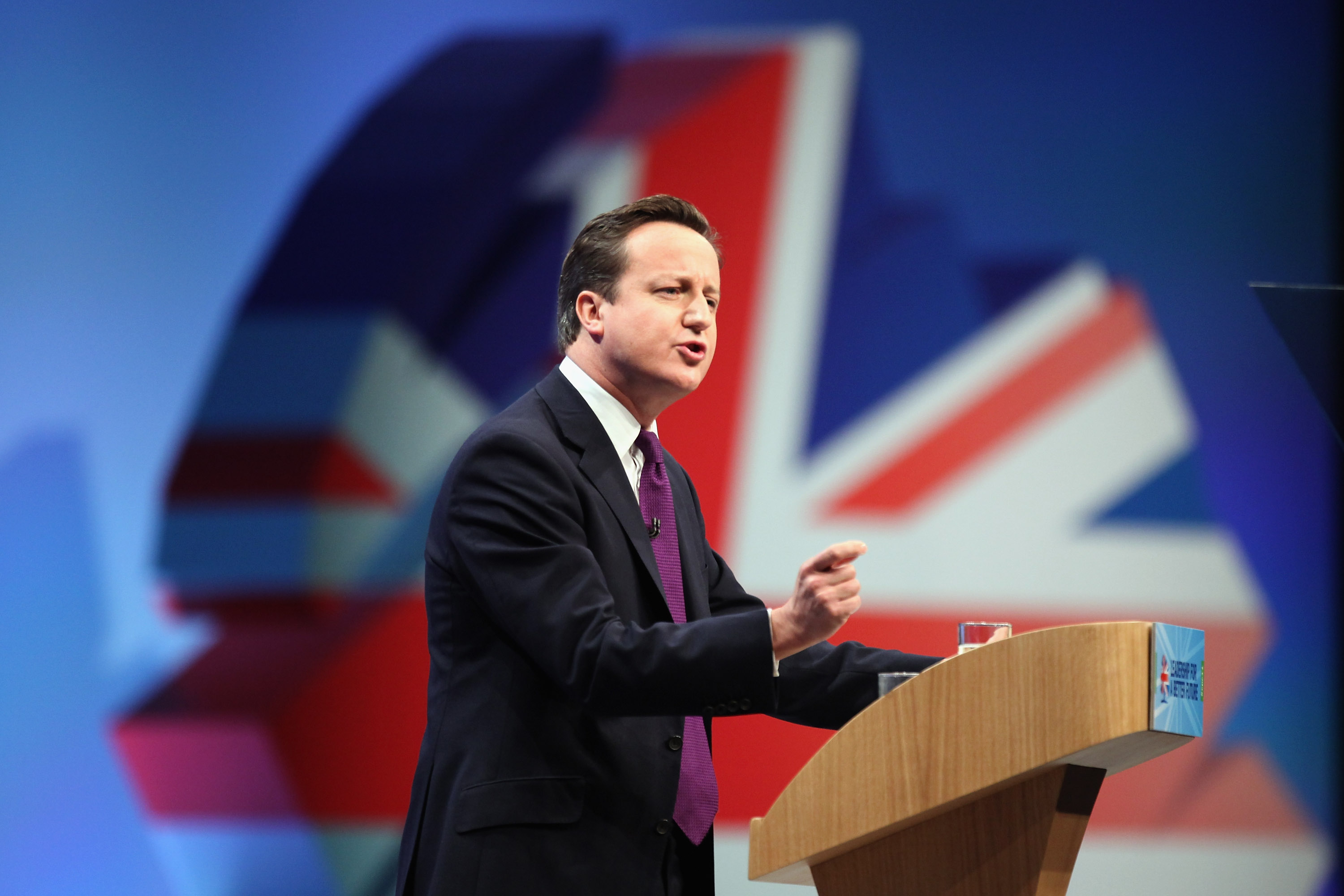
British Prime Minister David Cameron delivers his keynote speech to delegates at the annual Conservative Party Conference at Manchester Central on October 5, 2011 in Manchester, England. (Photo: Jeff J Mitchell / Getty Images)
Choreographed political events rarely provoke serious questions, much less existential ones. After all, a key aim of the choreographers is to skirt debate lest debate reads to the wider public like dissent. In that respect, Britain’s Conservatives can judge their four-day conference in the northern English city of Manchester, which concluded on Oct. 5 with a tub-thumper from their leader Prime Minister David Cameron, a resounding success. Ideological rifts amongst party members—most profound over Europe—were all but banished from the main stage, although two Cabinet ministers did trade blows over whether the Human Rights Act, brought in during Tony Blair’s Labour government to enshrine in British law tenets of the European Convention on Human Rights, enabled a Bolivian illegal immigrant to plead ownership of a cat called Maya to avoid deportation. And a flurry of criticism of a planned line from Cameron’s speech trailed in advance by his advisers led to an 11th-hour rewrite. (The Prime Minister had intended a phrasing that implied Britons, like their government, should pay off their debts; after protest that he ought to encourage consumer spending in these recessionary times, not dampen it, Cameron changed the sentence to a statement that Britons were paying off their credit and store card bills.)
But these were minor glitches in a smooth operation. A common criticism across all British media was that the conference was dull and news-free. Cameron will be delighted. He had hoped there would be only one memorable YouTube clip from the long season of political jamborees: the moment during Labour’s conference when its leader Ed Miliband mentioned Blair’s name. Delegates booed, revealing schisms opened by Blair’s support for the invasion of Iraq and long rivalry with successor Gordon Brown that served to render unelectable the party that Blair had made unbeatable.”We don’t boo our leaders,” said Cameron in his own speech. “We’re proud of what they did for our party and what they did for our country.”
Yet Cameron should temper his pleasure at a job well done, an electorate well and truly bored. Because although the Conservative conference dodged controversy, it raised great and troubling and fundamental questions and left them hanging. Questions like: what is the point of political engagement through mainstream parties if policies are anyway decided by a small elite? What is the point of party conferences other than to boost the drinks industry? What is the point of national leadership in a world buffeted by global forces? What is the point of anything at all?
The last question may simply reflect this correspondent’s exhaustion after the protracted, booze-fueled conference season and a series of power cuts and disruptions at my hotel in Manchester that peaked with the energy-sapping 4.40 am evacuation on Oct. 4 of all guests from the 23-storey building. But it’s also true that the unexpected opportunity to see politicians in their pyjamas provided at least as much insight into their values and habits as their more scripted appearances at the podium.
For years and increasingly, MPs and activists have shown more leg at the so-called fringe events, debates, speeches and receptions at the margin of conferences, than in their contributions to the official program. Conservatives did so again this year. In the past such demonstrations of independence—and sometimes of open rebellion—might have signaled trouble for the Prime Minister and his government. What was striking was not an absence of dissenting voices but the realization that they would have precious little impact.
That’s partly because Cameron and his coalition government have no intention of testing their popularity with voters any time soon and recently passed a law that sets the next election date in the distant future of 2015. No wonder the mix at all the conferences, but especially at the Conservatives’ gathering, skewed further than in previous years towards paid lobbyists than party activists. (In these straightened times, the cost of attendance also deters delegates who aren’t sponsored by corporations and other organizations.) Yet there’s another, and more disturbing reason why the grassroots have slim hopes of altering the course of events. It’s because Cameron and his coalition government have remarkably little power themselves to change the course of events.
Cameron tried to finesse the problem in his speech. He said:
As we meet here in Manchester, the threat to the world economy—and to Britain—is as serious today as it was in 2008 when world recession loomed. The euro zone is in crisis, the French and German economies have slowed to a standstill; even mighty America is being questioned about her debts.
It is an anxious time. Prices and bills keep going up—petrol, the weekly shop, electricity. On the news it’s job losses, cutbacks, closures. You think about [newly increased university] tuition fees, and house prices, the cost of a deposit, and wonder how our children are going to manage. Of course, government can help – and this one is.
He went on to identify the nature of that help: cutting duties on gas, subsidizing energy bills for the elderly and freezing municipal taxes (though raising others). He added: “People understand that when the economy goes into recession, times get tough. But normally, after a while, things pick up. Strong growth returns. People get back into work. This time, it’s not like that.”
Indeed it’s not. And as the Conservatives convened and talked and partied and drank, bigger news piled up nearby. Greeks protested the austerity measures that nobody really believes will prevent the country from defaulting on its huge debts. Italy surrendered Amanda Knox—and, of greater significance in the grand scheme of things, its Aa2 credit rating. Britain itself published horrible second quarter 2011 growth figures of 0.1%, half the modest projection.
Cameron and his colleagues claim bold plans to stimulate the economy and to ensure liquidity no matter what happens beyond British borders. Many Conservative delegates—and their non-aligned compatriots—would like to believe them. People want government to steer them safely through the turbulence or, in Cameron’s keynote soundbite, to “turn this ship around.” Polls indicate that Cameron commands more faith than his fellow party leaders. If the agglomeration of small measures to boost business, improve efficiency and diminish national debt agreed by the coalition are the way to go, Britons’ trust won’t be misplaced. “Let this time of challenge be turned into a time of opportunity,” urged Cameron. Watching him at the lectern, one man before a disempowered audience, it was hard to imagine what that might mean.
Catherine Mayer is London Bureau Chief at TIME. Find her on Twitter at @Catherine_Mayer or on Facebook at Facebook/Amortality-the-Pleasures-and-Perils-of-Living-Agelessly . You can also continue the discussion on TIME’s Facebook page and on Twitter at @TIME .