


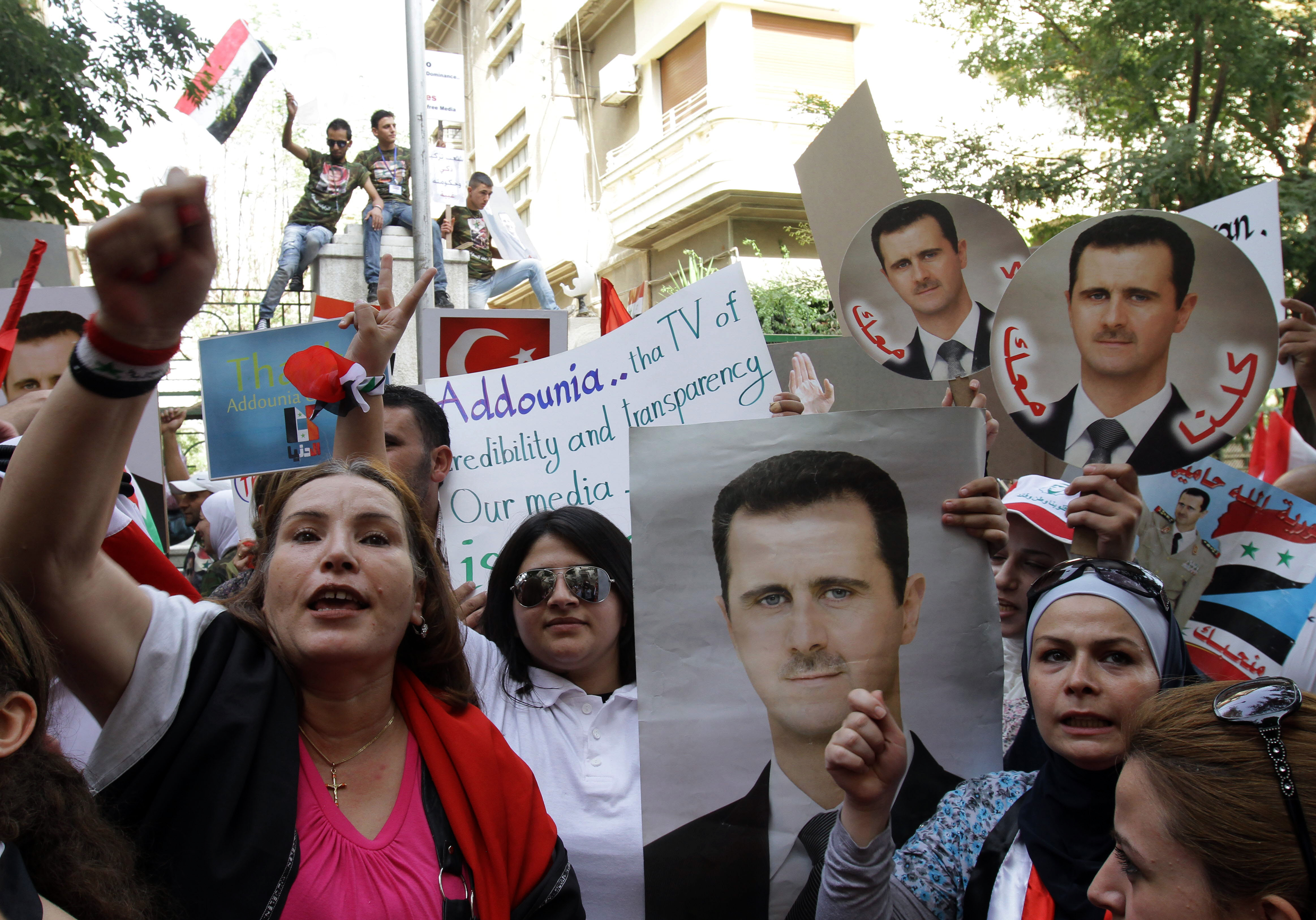
Syrian citizens and journalists holds portraits of President Bashar al-Assad as they protest outside the EU offices in Damascus on September 29, 2011 against new EU sanctions imposed on the pro-government Addounia television channel and five other companies. (Photo: Louai Beshara / AFP / Getty Images)
Nobody ought to be surprised by the Russian and Chinese vetoes of a U.N. Security Council resolution condemning Syria’s brutal crackdown on its citizenry and hinting that sanctions could be invoked if repression continues. That sanctions threat had been watered down in the hope of winning Russian and Chinese consent, but to no avail — Moscow and Beijing see themselves as having been burned by the Western powers on Libya, making them view authorization of any action against Syria as opening the way to yet another military intervention. While the Russian and Chinese position was backed by other important Security Council members who shared their view on Libya, a crucial exception was Turkey — which not only supported the resolution, but vowed to impose its own sanctions on Syria despite the U.N. vote.
“During this season of change, the people of the Middle East can now see clearly which nations have chosen to ignore their calls for democracy and instead prop up desperate, cruel dictators,” huffed U.S. Ambassador to the U.N. Susan Rice — perhaps oblivious to the irony that the people of the Middle East have also taken note of which nations are supporting and which are opposing the Palestinians’ efforts to claim their rights at the U.N.
Rice suggested that Russia’s veto was motivated by its desire to continue selling arms to the Assad regime, but China, Brazil, India and South Africa all joined Moscow in opposing the resolution, and none of them does a significant arms trade with Syria. Instead, like Russia, they made clear that their own votes were based on the Libya experience, where the Security Council’s authorization of a mission to protect civilians had been used as cover for a military campaign for regime change: As those countries see it, Libya was an object lesson in Western powers abusing U.N. authorization for action, and exceeding its limits, in order to pursue their own agenda. Hence their folded arms in the face of Syria’s ongoing brutality.
Western leaders accuse the opponents of the resolution of supporting the Assad regime, which may well be true to a greater or lesser extent for some of them. They’re certainly more inclined to share the Assad regime’s view that the conflict unfolding in Syria — like the one in Libya — is a civil war. That may have become a self-fulfilling prophecy as the repression meted out by the regime against non-violent protestors amplifies calls for an armed struggle against Assad. The regime is casting the conflict as a sectarian Islamist insurgency, and doing its best to provoke such, in the hope of shoring up its support among the Alawite and Christian minorities. Seven months into the rebellion, the city of Homs has seen opposition elements arm themselves, in clashes that have indeed taken on a sectarian character, pitting Sunni opposition groups against Alawites. That helps Assad cast the opposition as a mortal threat to Alawites and Christians, and also helps the likes of Russia present the situation as a civil war rather than a people vs. dictatorship scenario.
Libya notwithstanding, however, the Russians, Chinese and their allies have little reason to fear Western military intervention in Syria. Tiny Libya was low-hanging fruit, with prized oil assets and a danger of refugees flooding into southern Europe, and little potential spillover in its immediate neighborhood. Syria is altogether more substantial, with the regime maintaining a solid base of support, and a mortal assault on it raising potentially cataclysmic consequences for Israel, Lebanon and Iraq (even Turkey, to a lesser extent). And then there’s the fact that the U.S. and its NATO allies are all tapped out when it comes to expeditionary warfare, looking to end their entanglements in Afghanistan, Iraq and Libya amid a growing economic crisis that trims their strategic ambitions. All along, the U.S. and its allies have tried to send the Syrian opposition the message that they shouldn’t, in fact, operate on the assumption that they can expect a military intervention to save them.
One bright spot for the U.S. — and for the Syrian opposition — is the position of Turkey, Syria’s most powerful neighbor and one of its largest trading partners. Underscoring its increasingly assertive and independent regional role — which has vexed Washington on issues such as Israel and Iran, where Ankara has challenged U.S. policy — Turkey is taking a lead in moves to pressure the Assad regime to halt its repression. Prime Minister Recep Tayyip Erdogan broke with his BRIC allies (Russia, China, India and South Africa) to strongly support the Security Council resolution, and chided those who opposed it.
“The Syrian administration should have received a warning,” Erdogan said Wednesday of the vote, during a visit to South Africa (which abstained in the Security Council. “The people of that country do not need to endure a merciless, shameless, tyrannical regime that bombs its own country from the sea. My heart remains with those struggling for freedom. South Africans have been in that position.”
And such scolding will carry more weight in Pretoria coming from Turkey, given its positions on the Palestinian vote, Iran and even the Libya intervention, than it does coming from Washington. Nor was the Turkish leader ready to accept the Security Council’s verdict as the last word. Instead, he promised, Turkey will immediately impose new sanctions of its own, in concert with European Union countries.