


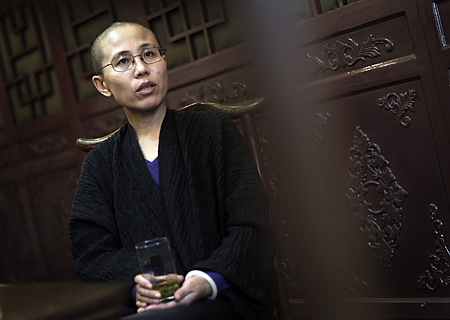
In this Sept. 28, 2010 photo, Liu Xia, wife of Chinese dissident Liu Xiaobo, speaks during an interview in Beijing, China. (Photo: Andy Wong / AP)
On Friday the Norwegian Nobel Committee will announce the 2011 Peace Prize laureate. Bookmakers Paddy Power, which correctly predicted Chinese dissident Liu Xiaobo’s win last year, currently list Sima Samar, chairperson of the Afghan Independent Human Rights Commission, as favorite, at 5/4. She is followed by Burmese opposition leader and previous Peace Prize laureate Aung Sang Suu Kyi, at 4/1. A bit further down the list, each at 20/1, are three Chinese activists: Hu Jia, Wei Jingsheng and Chen Guangcheng.
It is safe to say that any wagers placed on another Chinese winning the Nobel Peace Prize this year would be wasted. The political changes that swept the Arab world this year have crashed impotently against a seawall of state power in China. The government’s response was to unleash a harsh crackdown on activists, disappearing dozens and blocking any attempts at public protest last spring. New legislation now under consideration would make secret detention, without any notice for family members, legal for periods of up to six months in cases of terrorism, state security or serious corruption, which human rights groups fear will be used to silence dissent.
The most significant aspect of Chinese activists this past year has been their silence, which has been achieved through disappearance, intimidation and abuse. Ai Weiwei, the artist and activist, spent nearly three months in detention on tax evasion charges and is now out on a form of bail, his movements and freedom to speak out restricted. Chen, a blind legal activist, is being held with his wife in a harsh form of house arrest in their village in Shandong province, despite completing a four-year prison term for damaging property and organizing an illegal protest. The couple’s six-year-old daughter has been blocked from attending school. Gao Zhisheng, a dissident lawyer who was convicted of subversion in 2006 and has described suffering extensive abuse in detention, remains missing and is presumably being held by authorities.
Liu, the Nobel Laureate, lingers in a cell in the northeastern city of Jinzhou, where he is serving an 11-year sentence for “inciting subversion of state power.” His brother said in an interview with Agence France-Presse that Liu, 55, was allowed to leave the prison briefly last month for his father’s funeral. Liu Xiaoxuan told the news agency that he had visited his brother last week, and that Liu’s wife, Liu Xia, had visited him in August. Since her husband was awarded the prize last year she has lived under house arrest, unable to communicate with the outside world.
What’s most remarkable about her situation is that she had been given relative freedom to move and accept interviews after her husband was sentenced on Dec. 25, 2009. It was only after he was given the Nobel Peace Prize last year that she was placed under such harsh restrictions. “As far as I know, the way she is treated is unprecedented in the history of the Nobel Peace Prize,” Norwegian Nobel Committee secretary Geir Lundestad told the Associated Press earlier this week. “Her situation is extremely regrettable.” Neither Liu Xiaobo nor Liu Xia were allowed to attend the Peace Prize ceremony last December in Oslo. His medal was instead placed on an empty chair. But even without it around his neck, the prize weighs heavily on Liu and his wife both.
Austin Ramzy is Beijing correspondent for TIME. Find him on Twitter at @austinramzy. You can also continue the discussion on TIME’s Facebook page and on Twitter at @TIME.