


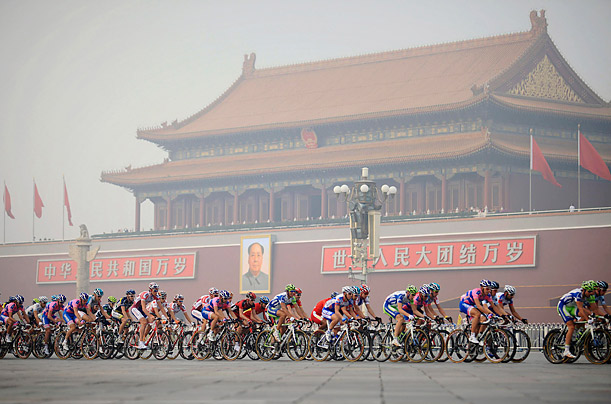
Cyclists ride through Tiananmen Square during the 2011 Tour of Beijing, October 9, 2011. (Photo: China Daily / Reuters)
His red leader’s jersey muted by smog, German Tony Martin won the inaugural Tour of Beijing Sunday, the first world class road cycling event in the Chinese capital since the 2008 Olympics. As a cycling fan, I stood by the road to watch both events, and yesterday it struck me how the city has changed over the past three years.
The most inescapable difference was the air. In 2008, the men’s and women’s road races were some of the first events of the Olympics. For months the world wondered whether Beijing could control its notorious pollution for the Games. The air on those early days wasn’t perfect, but it wasn’t notably noxious either. Few cyclists complained. In the period that followed the extreme measures taken by the local government—shuttering local factories and construction projects, blocking one third of the city’s cars from the streets each day—began to have an effect, and the Chinese capital enjoyed a rare clarity.
On Sunday however Beijing was blanketed once again in an oppressive smog. Just walking was hard on the lungs, let alone competitive cycling. The monitor run by the U.S. Embassy registered readings of “hazardous” and, for a couple hours in the evening, “beyond index”—a level informally known as “crazy bad.”
If the air has changed since 2008, the security posture certainly hasn’t. The level of protection the Olympic riders received was unlike anything I’d witnessed. Even at the highest level of sport, like the Tour de France and the spring classics, the field must funnel through huge crowds of fans that line climbs and cobbled sections. Riders are occasionally knocked down by fans who are overenthusiastic, drunk or oblivious. But in China race courses are protected by one or two layers of security that make getting close to the action impossible.
In 2008, police shut down the roads in advance of the peloton’s passing, blocking anyone from crossing the road for a good half hour. The arrival of the field was preceded by more than a dozen police and security vehicles. Anyone wishing to interfere with the race would have been dragged off before the riders even passed by. For the Tour of Beijing, the security level has been similar, with police and security guards lining the road for miles. The starting time trial and Sunday’s finishing circuit were largely off-limits to average fans, which boosted safety but created a sterile racing environment. Local radio even advised anyone who didn’t have to work Sunday to stay home and avoid the traffic closures. For those who watched from the roadside, the field passed by in a distant haze.
Austin Ramzy is Beijing correspondent for TIME. Find him on Twitter at @austinramzy. You can also continue the discussion on TIME’s Facebook page and on Twitter at @TIME.