


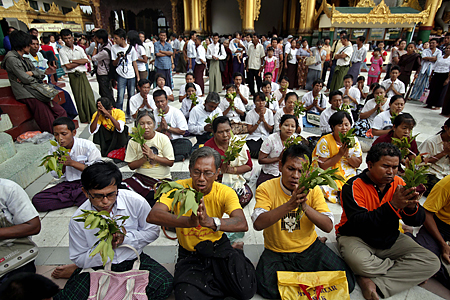
Democracy activists pray on the platform of the Shwedagon pagoda in Rangoon, Burma, September 27, 2011. (Photo: Nyein Chan Naing / EPA)
Squeezed between booming India and equally booming China, Burma has long felt like a time capsule of repressive rule, economic mismanagement and military dominance. But is change finally coming to this strategic crossroads? On Oct. 11, in a state T.V. announcement emblazoned with a “breaking news” banner, the country’s government announced a prisoner amnesty affecting 6,359 inmates that would begin on Wednesday, potentially leading to freedom for some of the country’s 2,000 or so political prisoners. The same day, a government-run human-rights council urged in an open letter to state media that “what is referred to as prisoners of conscience” be released, in order to promote the task of “nation-building.”
In 2009 and May of this year, Burma, also known as Myanmar, granted amnesty to tens of thousands of inmates, however, few political prisoners were released. But this time the fact that the government human-rights commission acknowledged the existence of prisoners of conscience, plus positive noises made by Foreign Minister Wunna Maung Lwin at the U.N. late last month, are buoying hopes. The release of Burma’s political prisoners—who range from politicians, monks and journalists to lawyers, ethnic activists and a famous comedian—might encourage Nobel Peace Prize laureate Aung San Suu Kyi to call for an end Western sanctions on the regime. Some outside observers have called the economic restrictions noble but ineffective, given that Burma freely trades with its Asian neighbors, most notably China and Thailand. But so far, opposition icon Suu Kyi has continued to support the sanctions.
In recent weeks, Burma’s leaders have not only made human-rights concessions that are pleasing the West but they have also distanced themselves from the country’s biggest trading partner and patron, China. Last month, Prime Minister Thein Sein, a retired general who now heads the country’s nominally civilian government, suspended a $3.6 billion Chinese-directed dam in northern Burma that was designed to send most of its future electricity over the border to China. The abrupt decision on the Myitsone hydropower project initially led to grumbles from China’s Foreign Ministry, but on Oct. 10, Wunna Maung Lwin visited Beijing to smooth over relations.
Thein Sein has also met in recent weeks with Suu Kyi, who was released from house arrest last year, just days after carefully orchestrated elections in which her National League for Democracy (NLD) did not take part. (The last polls in 1990, which her NLD won, were ignored by the ruling junta.) Critics say the current government is merely a civilian figleaf for the military regime. Nevertheless, there’s no question that promises of reform are beginning to play out—perhaps because Burma wants support in its campaign to chair the Association of Southeast Asian Nations in 2014.
Last week, in a startling interview with Radio Free Asia, Burma’s censorship chief hinted that his own bureau should be disbanded. Tint Swe, the head of the Press Scrutiny and Registration Department, said Burma should accept press freedoms in its near future. Last month, websites that had long been banned, like the BBC and YouTube, were unblocked. But press restrictions still remain, and a Burmese magazine that put Suu Kyi on the cover last month was suspended for a fortnight. At least two journalists have been imprisoned in the past year for their work.
On Monday, Kurt Campbell, U.S. Assistant Secretary of State for East Asian and Pacific Affairs, acknowledged that there were “dramatic developments underway” in Burma. “The United States is prepared to match the steps that have been taken,” he said during a stop in Bangkok. As the prisoners being walking out of some of the world’s most notorious jails tomorrow, the world will see just how many steps Burma is willing to take toward real change.