


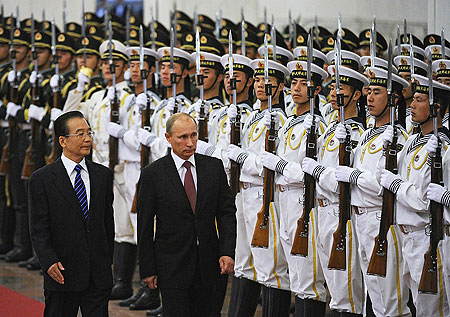
Russia's Prime Minister Vladimir Putin (C) and China's Premier Wen Jiabao (L) inspect an honour guard during a welcome ceremony at the Great Hall of the People in Beijing on October 11, 2011 (Photo: Takuro Yabe / POOL / AFP)
Regular readers of stories from China’s state-run Xinhua News Agency know that relations between China and nearly every country whose leader visits Beijing merit a positive appraisal. “Malawi treasures its friendship with China and is grateful for China’s selfless support for Malawi’s national development,” gushed one Xinhua article last year, while another on Oct. 11 noted that “China and Namibia have become ‘all-weather’ friends.” Today, as Russia’s Vladimir Putin began a two-day trip to China accompanied by a 160-member delegation, a Xinhua op-ed piece proclaimed: “China-Russia cooperation conducive to a more balanced world.” The Chinese media group splashed “rarely-seen photos” of Putin and his family members of its website homepage, along with a link to a close-up of the Russian leader captioned: “Cute or cool, another face of Russian Prime Minister Putin.”
As evidence of this “more balanced world,” Xinhua pointed to China and Russia’s joint rejection of a U.N. draft resolution on Syria that would have condemned Damascus for its deadly crackdown on protestors. Xinhua also opined that “as key members of the Shanghai Cooperation Organization and leading emerging nations, China and Russia have played an important role in shaping a multipolar world and fostering democratization of international order.” The Shanghai Cooperation Organization is a grouping of China, Russia and Central Asian nations that presents an alternate security alliance to NATO. Closer Russian-Chinese ties could provide a counterbalance to relations with the West.
Ahead of Putin’s China visit, some $7 billion in trade deals were discussed, according to the Chinese Foreign Ministry. (China is now Russia’s top trading partner, and trade will likely surpass $70 billion this year.) Further economic cooperation is expected to be finalized during Putin’s China stop—the Russian Prime Minister’s first trip abroad since he announced a controversial leadership plan in which he would try to reclaim the more important title of President next year.
But as the relatively muted words of Xinhua—only a “balanced world” and “pragmatic policies,” not “relations at an all-time high” or some other usual superlative?—portend, relations between Moscow and Beijing are complicated. Even though China has succeeded in securing natural resources across the globe, a giant gas deal with Russia, with which it shares a long border, has foundered. Then there’s the small matter of a Chinese who is being accused by Moscow of trying to obtain classified information on a Russian surface-to-air missile system. Even though the alleged Chinese spy has been held by Russian intelligence services for a year, information about his case was released by Moscow just last week—peculiar timing given that Putin would soon be jaunting off to Beijing. Much has been made of China and Russia’s historical communist ties. But the cold war was just as noteworthy for the Sino-Soviet split as it was for any sense of socialist brotherhood.