


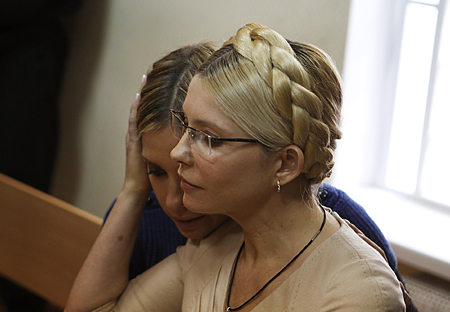
Ukrainian ex-prime minister Yulia Tymoshenko (R) and her daughter Yevhenia attend a session at the Pecherskiy district court in Kiev October 11, 2011. (Photo: Gleb Garanich / Reuters)
In the three days since a Ukrainian court convicted ex-Prime Minister Yulia Tymoshenko of abuse of power, the country’s president Viktor Yanukovych has been portrayed as a modern-day Joseph Stalin. Leaders from Brussels to Moscow accused his regime of staging a show trial in which his main political rival was sentenced to seven years in prison, fined $188 million and barred from contesting next year’s presidential election.
For a split second it seemed that Yanukovych might adopt a conciliatory tone. Following the verdict he said that Tymoshenko’s sentence could be reversed during appeal, and on Oct. 13 he expressed support for de-criminalizing the article under which she had been convicted. But any chance Yanukovych had of mitigating the diplomatic fallout evaporated on Wednesday with the news that his government is bringing a second criminal case against Tymoshenko. This ham-fisted maneuvering will do little to dispel suspicions that Yanukovych is abusing his power in a crass attempt to discredit a rival, and push Ukraine further into diplomatic isolation.
The new charges leveled against Tymoshenko accuse her of embezzling $405 million in 1997 while serving as president of United Energy Systems of Ukraine (UESU), the natural gas trading company she founded. The SBU, the Ukrainian Security Service, claims that Tymoshenko reassigned the debt—which UESU owed to Russia’s Ministry of Defense—to Ukraine’s national budget, and then transferred the amount in question to her personal bank account. Authorities say she deposited some of those funds into accounts belonging to her close ally Pavlo Lazarenko—Ukraine’s prime minister at the time. Lazarenko, who is currently serving a money laundering sentence in the United States, also faces charges. Tymoshenko’s lawyer has previously said the rumors of her involvement are “absurd,” since the debt is owed by UESU, which was dissolved in 2009.
The investigation into the debts kicked off in July, following Russia’s June 10 request that Ukraine re-pay the money. That’s raised eyebrows that Russia might be playing a complicated game meant to discredit both Tymoshenko and Yanukovych in the eyes of the E.U., the goal being to prevent Brussels from getting too cozy with Kiev. Russian Prime Minister Vladimir Putin is currently pushing for a “Eurasian Union” made up of former Soviet states that he claims could serve as a counterweight to the E.U. and China. It’s known that he would like Ukraine to sign up. But Ukraine’s impending Association Agreement with the E.U. precludes that. Yanukovych’s committment to European integration has already prevented Ukraine from entering into an existing customs union with Russia, Belarus and Kazakhstan, which is the nucleus of Putin’s proposed union.
Oleksandr Turchynov, deputy leader of Tymoshenko’s “Fatherland” party, says that Ukraine owes Russia nothing. “This is nonsense, and I’m sure that if the debt was really secured by state guarantees then Russia wouldn’t have waited 15 years,” he said at a press briefing. But Turchynov, like so many others, is focused less on Russia’s request than on the SBU’s investigation. “There is only one goal behind new investigations – to not let Yulia Tymoshenko out of jail,” he said. “There is only one form of existence for the regime – political repression and attempts to destroy opponents, and their main opponent is Yulia Tymoshenko.”
William Lee Adams is a staff writer at the London bureau of TIME. Find him on Twitter at @willyleeadams or on Facebook. You can also continue the discussion on TIME’s Facebook page and on Twitter at @TIME.