


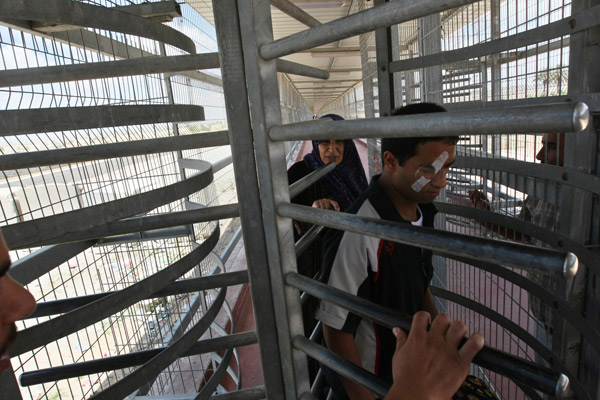
Palestinians walk through the Erez border crossing with Israel in the northern Gaza Strip as they cross into Gaza, on June 09, 2010. (Mahmud Hams-AFP-Getty Images)
It used to feel like tunnels were the only way to get into Gaza. And on the Strip’s western boundary, they still are – dozens of actual subterranean passages that run from sovereign Egypt on one side to the Palestinian territory on the other, freightways to haul in everything from tuna to Toyotas to lions.
But the way in from Israel only seemed underground. It was simply a long, long sheath of sheet metal, like the world’s deepest machine shed. This was the passage built to accommodate the thousands of Gazans who commuted to jobs in Israel every day, back in the time when Palestinians could work in Israel. By the time I showed up, in August 2005, those days were over, and a visitor was a rare thing who had the long, empty, twilit space to himself. It went on and on and on, and at the time was surely one of the most remarkable journeys on the planet. You felt as though you started in Europe, walked a very long way in the half-light, and came out in Africa, a land of sand and broken walls and plastic bags clinging to stubbly plants. It was as if you’d passed underneath the Mediterranean.
Things change. Israel still doesn’t permit Gazans to cross for work; the few it admits each day are humanitarian cases, en route to Israeli hospitals. But the crossing has been transformed as if they were expecting thousands. A giant terminal went up, the kind you find at an airport, if an airport were given over entirely to security. There is glass and airy spaces, immigration booths, sterile order where there used to be, at the Israeli end of the long tunnel shed, a clunky, terrifying checkpoint of dirty concrete, painted steel and bulletproof glass thick as a finger. You stood in front of it but well back, half expecting to be shot, no idea what was expected of you, and when impatient instructions blared from a distorting loudspeaker it only felt worse.
Now the visitor stands at an immigration booth. Your passport is stamped, the formalities of an international frontier enforced because since pulling out its heavily fortified settlements in 2005 Israel maintains it no longer occupies Gaza. Beyond the booth, silence. You proceed alone into a building with very high ceilings, the way marked by arrows and the word “Gaza,” through a corridor, around a bend, through a revolving gate and across an empty space to a heavy door painted white. Stand in front of it, and it slides open. On the other side is an Arab man with a trolley. “Fifty shekels?” he says.
The tunnel is no more. The new walkway to Gaza has a roof but no walls, a pedestrian way open to the air through cyclone fencing. The views are both desolate and arresting. On the left, a brown plain stretching toward the Israeli kibbutzim hunkered against the homemade rockets still occasionally fired by Palestinian militants. To the right, atop the towering concrete wall that reaches over the dunes toward the sea, a remote control turret for a massive machine gun, looming robotic and fearsome.
And on both sides, rubble. Broken concrete is the defining feature of what the journalist Mitchell Prothero called “this wretched cornice.” A little farther into Gaza, beyond the neutral zone enforced by Israeli gunners, the landscape comes alive, in a weary, desultory way, with young men lifting chunks onto donkey carts. The carts gather at dusty open-air mills on the road toward Gaza City, where the blocks are pulverized and the re-bar stacked to be used again, with the bits of aggregate, in rebuilding houses and businesses destroyed in the three-week assault Israel launched in December 2008, after the rocket fire became too routine.
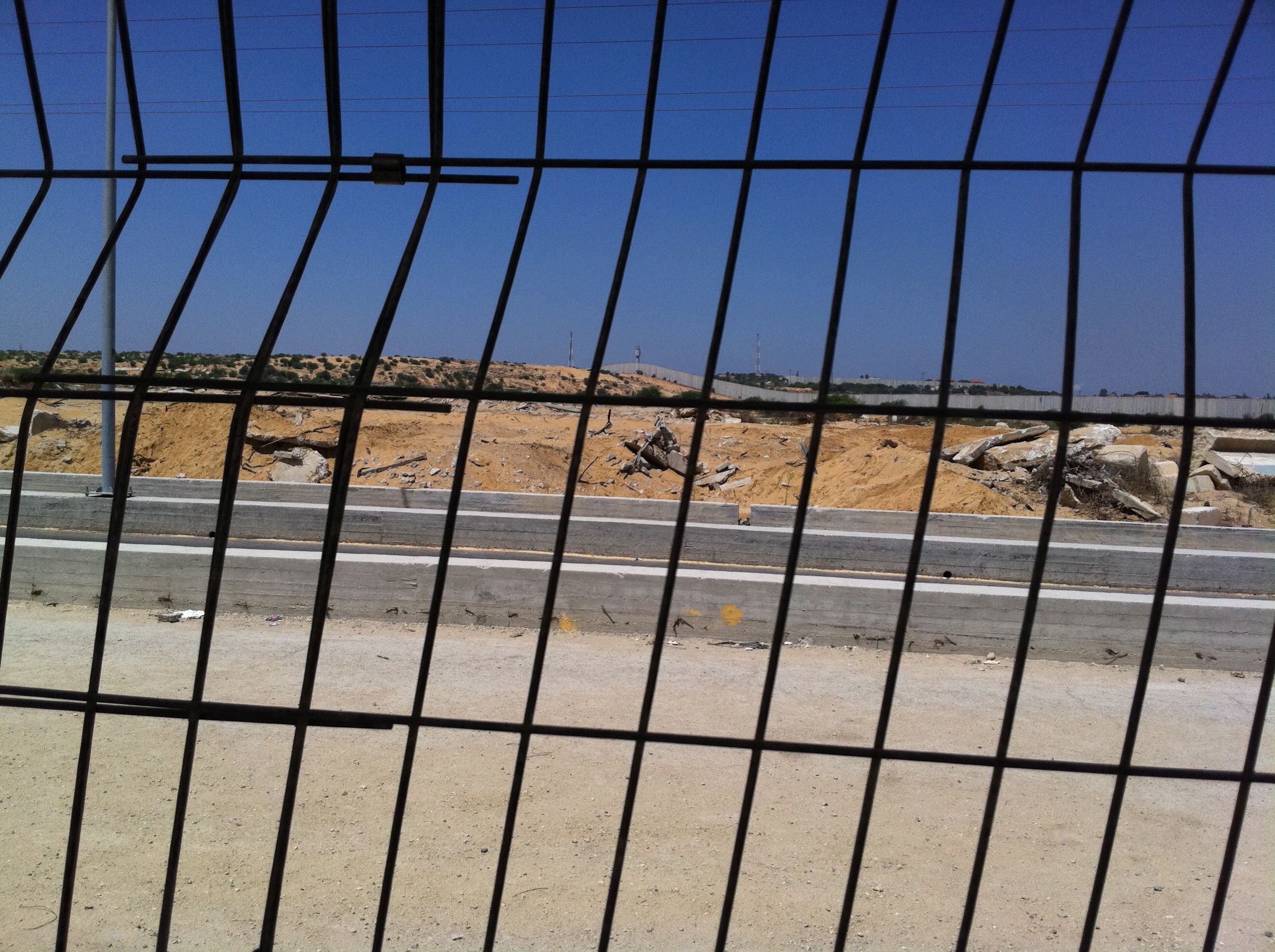
But what was this the rubble of? “It was the Erez Industrial Zone,” a Gazan reminded me. Exactly. For three decades, Erez was where Israeli companies employed thousands of Gazans at a sprawling industrial park, a buffer zone where interests overlapped.
Then it was ordered abandoned and broken to bits, both to deny militants cover and because no one could imagine it opening again.