


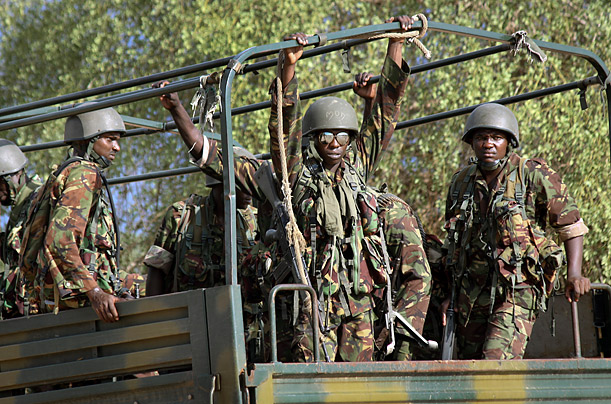
Kenyan military board a truck headed to the Somali border, October 18, 2011. (Photo: AP)
If the history of war teaches us anything, it’s that invading a foreign country is dicey. Storming across too many borders was the undoing of many of the world’s great conquerors, from Alexander the Great to Napoleon to the Nazis. The last few decades of US foreign policy – Vietnam, Afghanistan, Iraq – only underline how tricky invasions are, even for the most powerful. The last 20 years have also seen Somalia emerge with a particularly consistent record of chewing up anyone who arrives carrying a gun, including the U.N. and U.S. special operations troops (1992-3), Ethiopians (2006-9) and Ugandans and Burundians from an African Union peacekeeping force (2008-today).
So what does Kenya think it’s doing? On Sunday, a force estimated variously at a few hundred to 2,000 Kenyan soldiers crossed the border into Somalia into pursuit of militants from the Somali Islamist group, al-Shabab. The invasion came after a rash of armed incursions into Kenya from Somalia. On Sept. 11, Somali gunmen killed British tourist David Tebbutt, 58, and abducted his wife Judith, 56, from a resort on the northern Kenyan coast. In a second attack on a nearby beach hotel on Oct. 1, another group of Somali gunmen kidnapped a 66-year-old disabled French tourist, Marie Dedieu, who was confirmed dead on Wednesday. And then on Oct. 13, a third group of kidnappers took two Spanish aid workers from Dadaab, a camp in northern Kenyan — the biggest refugee settlement in the world, set up 20 years ago for those fleeing fighting and famine in Somalia.
Starting a war is not an obvious way to bolster a country’s reputation for safety and security. Starting a war with an al-Qaeda affiliate who have previously carried out attacks abroad (in Kampala in July 2010 two al-Shabab suicide bombers killed 76 people) and who have been itching for an excuse to do the same to you carries even more obvious risks. But starting a war in which your invading forces are outnumbered from the beginning (al-Shabab has around 2,500 men at arms), and doing that just as the rainy season starts, is bat crazy.
Sure enough, by Wednesday the Kenyans and their Somali allies were stuck in torrential rains and thick mud 20 miles short of their first objective of the al-Shabab-ruled town Afmadow. Even if the occupiers can extract themselves from the literal quagmire, analysts unanimously agree they will find it all but impossible to avoid becoming militarily bogged down. Faced with al-Shabab’s well-armed, experienced and more numerous guerrillas – fighters who two years ago saw off a far fiercer, better trained and bigger Ethiopian force – Kenya’s soldiers seem headed for deadlock at best and, at worst, bloody defeat. What’s worse, the Kenyan invasion seems likely to reunify al-Shabab just as it was in danger of splintering over disagreements about leadership and whether to accept aid to alleviate an ongoing famine in southern Somalia. It could even help restore al-Shabab’s plummeting local support.
History may be littered with warnings about just this kind of action but still, rarely has disaster been so plainly foretold. As an al-Shabab spokesman, Ali Mohamud Rage, told the BBC, while vowing retaliatory attacks on Nairobi: “Kenya doesn’t know war. We know war. We have fought against governments older and stronger than Kenya and we have defeated them.”