


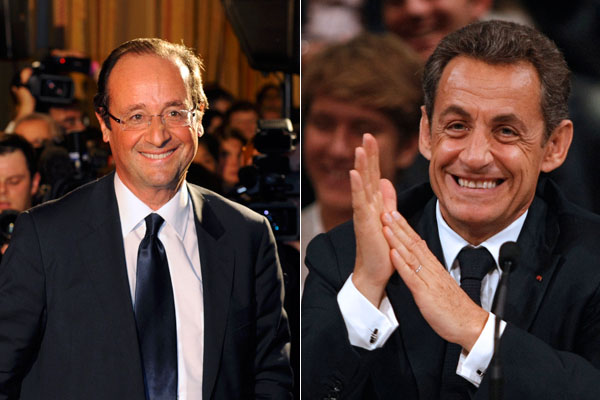
Francois Hollande and Nicolas Sarkozy (Photos, l. to r.: Gonzalo Fuentes / Reuters; Lionel Cironneau / AP
For anyone who hasn’t done so yet, I suggest having a read of a very well-focused and evenly-argued story by Gavin Hewitt, Europe editor for BBC News, on the opportunities and challenges for power-seeking European leftist parties at the very moment when French Socialist candidate François Hollande looks like a decent bet to unseat conservative incumbent Nicolas Sarkozy for France’s presidency.
Hewitt not only hits most of the salient points within the looming Hollande-Sarkozy clash in a compact manner (and one which I clearly need to learn to replicate…). He also stresses how French Socialists and other Sarkozy opponents can’t simply rely on the wide-spread public rejection of the president’s leadership to beat him. Instead, they must step up and propose solid, convincing or even inspiring solutions to the economic and financial turmoil that sitting European governments (including Sarkozy’s) have failed to table thus far. Shooting at an unpopular ambulance may be easy and tempting, but even voters now disgusted with their current leaders will balk at change if options being proposed sound like simplistic contradiction.
That may sound like a “duh” reminder, but it’s a necessary one given the already materializing risks of hollow recrimination dominating debate —which is currently (and ironically) the case on the French right. In the wake of Hollande’s victory Sunday of his part’s presidential primary, Sarkozy’s ruling conservatives have found nothing better to offer than stage a televised “congress” attacking the still nascent Socialist platform as neo-Marxist, inapplicable to the modern world, and certain to ruin the French economy. In doing so, the French right has ignored the fact that it, alone, has dominated power since 2002, and reigned over the myriad mistakes and excesses (not all of its own doing) that have led France and most of Europe to the current crisis.
Hewitt doesn’t mention the French right’s reaction to Hollande’s win his Wednesday story. But what he does point out—quite correctly–is that if Hollande and the Socialists don’t seek to do better than simple carping at the unpopular, scandal-dogged Sarkozy by coming up with concrete, viable, and inspirational leadership plans of their own, they risk seeing voters do what publics across Europe generally have in the past decade: stick with the right as, at least, a known quantity. The time for the left is now, Hewitt says, but it’s still unclear whether European leftists are ready, willing, or able to rise to the occasion.
Apart from in Denmark, (leftists) have failed to take advantage of the global recession and the debt crisis. Their critics ask how they will deliver jobs, growth, and reduce the debts. How will the new public sector jobs be financed? So far they have struggled to find an answer.
(Hewitt also raises the interesting question of whether “New World” social systems and economies in Canada and Australia may hold answers for Europe’s creaking “Old World” welfare systems. More on that later–I’m focused on “compact” just now.)