


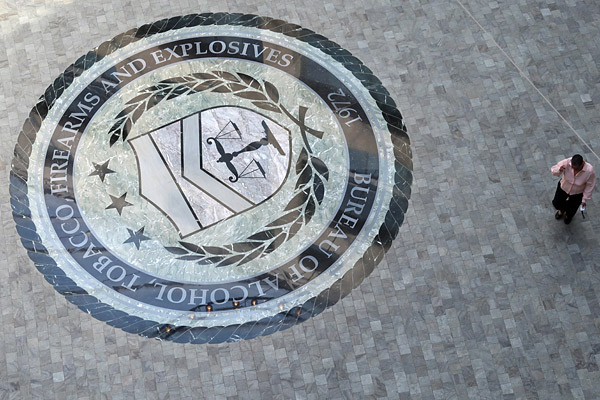
People walk through the courtyard at the Bureau of Alcohol, Tobacco, Firearms and Explosives (ATF) headquarters in Washington, D.C., U.S., on Tuesday, April 26, 2011. (Rich Clement / Bloomberg / Getty Images)
This week the U.S. Senate voted 99-0 to ban future “gunwalker” operations like the Obama Administration’s “Fast and Furious” debacle. “Fast and Furious” was the well-intentioned but awfully executed program headed by the U.S. Bureau of Alcohol, Tobacco, Firearms & Explosives (ATF) in Arizona that let hundreds of illegally purchased weapons get smuggled into Mexico so they could be tracked to criminal groups there. The problem: the ATF lost track of the guns – including two assault rifles found at the scene of the murder of U.S. Border Patrol agent Brian Terry last December.
The ATF director and the U.S. Attorney for Arizona have since been removed. But the ATF and the Justice Department have to be as transparent as possible as Congress probes this deadly fiasco – not only to ensure a proper investigation, but to salvage the good example that U.S. law enforcement is supposed to set for police in Mexico as that country confronts its powerful, violent drug cartels. The serious need for a model south of the border was underscored recently when the Mexican government, in unusually open fashion, released the salaries of the country’s notoriously underpaid state and local officers. Many believe that index explains not only why those cops are so ineffectual, but why so many if not most are so corruptible – so willing to moonlight for the drug mafias responsible for some 40,000 killings in Mexico in the past five years.
(See “Day of the Dead: The Drug War Is Mexico’s Tragedy. Now Its Survivors Are Fighting Back”)
The numbers, published by Mexico’s National Public Security System, are in fact telling. The average monthly pay for a state police officer in Mexico is 9,250 pesos, or about $685. That’s low enough by international standards. But in the border state of Tamaulipas – which today is all but under the control of Mexico’s most vicious drug gang, the Zetas – the salary is a miserable $268 per month. Mexico’s drug-trafficking cartels, which earn as much as $40 billion a year, have no trouble doubling or tripling that income for each officer they co-opt. In Chihuahua, home to the world’s most murderous city, the border town of Juárez, it’s only $590. In Guerrero, where ghastly drug-cartel beheadings now plague the once glamorous Pacific beach town of Acapulco, it’s even lower at $573. The pay in other drug violence-racked states like Michoacán, Sinaloa and Durango also fall below the national average.
But nothing, of course, is that clear-cut. In Nuevo León state, for example – where cities like Monterrey, Mexico’s business capital, have been overrun by drug thugs, some of whom recently killed 52 innocent people after setting fire to an upscale casino – the police pay is above average (though, at $700 a month, not much above average). What that points up is that better salaries, though critical, won’t solve Mexico’s cop crisis by itself. Other factors have to be addressed in order to develop the modern, professional constabularies that are the country’s only real long-term path to rule of law.
As important as money is morale – a sense, which Mexico has never instilled in its cops since Cortés conquered the Aztecs, that the institution of police work is essential, valued and dignified. In communities like the Monterrey suburb of San Pedro Garza García, for example, officials in recent years have begun supplementing pay raises with benefits like subsidized housing. They’ve also committed to arming their officers with the sort of heavier weaponry, like AR-15 assault rifles, that the gangsters have. Elsewhere, Mexican President Felipe Calderón is pushing to eliminate incorrigibly corrupt local police departments and create more uniform state forces (if not one single national force). Their stricter vetting, as well as 21st-century investigative technology and training, would finally make the country’s cops feel a part of something that can’t (or shouldn’t) be bought off by cartels.
The U.S., especially via bilateral efforts like the $1.5 billion Mérida Initiative, should play a large role in those reforms. In fact, given how large a role America’s insatiable appetite for illegal drugs and our reckless lack of gun control play in Mexicans’ narco-nightmare, it’s our obligation. And that makes it particularly important that our law enforcement be a model for theirs. It is: U.S. cops, anti-drug agents and prosecutors without a doubt remain the hemispheric if not global standard. That’s a big reason the U.S. side of the border is actually one of the nation’s safest corridors. And that’s precisely what makes the “Fast and Furious” blunder so infuriating to watch.