


Former Libyan leader Muammar Gaddafi at the opening of the African heads of State summit, where he was elected chairman of the African Union, February 2, 2009. (Photo: Simon Maina / AFP / Getty Images)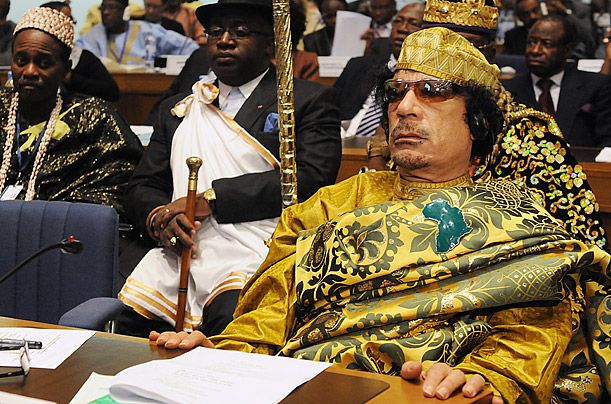
One of the more farcical moments in a reign steeped in the bizarre, Muammar Gaddafi’s 2008 coronation as the “king of kings” of Africa was an elaborate ceremony attended by a couple hundred African royals. From a mock throne, wielding a gleaming scepter, Gaddafi urged greater African unity, calling on the formation of a “United States of Africa” with a common army and currency. The dignitaries, mostly traditional chieftains or petty royals with only symbolic power, seemed happy enough to play along with yet another megalomaniacal Gaddafi spectacle.
Where did it take place? Why, in Benghazi, otherwise known as the stronghold of the rebellion that ousted Gaddafi from power this year—and the very city where Libya’s new NTC leaders stood in the main square last Sunday and heralded the country’s liberation from 42 years of Gaddafi tyranny days after he had been slain by rebel fighters. Not only was his body consigned to a dusty, secret grave in the desert, but so too his delusions to global power and preeminence.
Yet Gaddafi’s international legacy deserves more analysis. Spurned by many Arab states who had no time for his pan-Arabist posturing, Gaddafi had turned to Africa in recent years with a vast fund of his petro-wealth — some $5 billion — that he distributed as largesse throughout the continent. It won him the presidency of the African Union in 2009, though neither his attempt to extend his tenure nor calls for a more integrated federation met any success. But, after years of fomenting insurgencies, abetting militant action and grooming ideological pet projects around the world, Gaddafi’s pan-Africanism has left a mark. A report by the International Crisis Group, a New York and Brussels-based think tank, sums up the immediate effect of his exit from the scene:
Due to the length of his reign, his influence abroad and strong patronage politics, Qaddafi’s shadow will continue to be felt in Libya and neighbouring countries. The upheavals that preceded and followed his fall have created new and potential problems, including massive displacement of populations; tribal tensions within Libya and racist attacks against nationals of sub-Saharan countries; a possible resurgence of Islamism; and the proliferation of fighters and weapons.
Despite such chaos, Gaddafi still commands sympathy in sub-Saharan Africa. His pan-Africanism and support of liberation struggles against colonial rule won him the loyalty of Nelson Mandela. For all the evil that he may have perpetrated, there’s a larger narrative of justice on whose side he’s still somewhat on: that of Third World solidarity, a sentiment that once wove much of the developing world together during the Cold War.
Gaddafi took his ideological cues from Egypt’s Gamal Abdel Nasser, the pan-Arabist in chief, who, alongside other mythologized nation builders such as India’s first Prime Minister Jawaharlal Nehru, Ghana’s Kwame Nkrumah and Indonesia’s Sukarno, founded the Non-Aligned Movement, a supposed middle way between the capitalism of the West and the totalitarianism of the U.S.S.R.
Few stood taller in this project than Nehru — the suave, Oxbridge-educated statesman who, as India won its liberty in 1947, spoke famously of that moment when “the soul of a nation, long suppressed, finds utterance.” What captured the spirit of the times — and moved even a British prime minister to extol the “wind of change” sweeping through Africa — was the exhilarating sense of newness that independence seemed to promise. Land once hoarded by imperial aristocracies was being radically redistributed to peasant farmers. Prophets of high modernism, architects like Louis Kahn and the Swiss Le Corbusier, were drafted in to construct soaring edifices of power as new parliaments, monuments, cities rose from the earth. Led by charismatic, erudite men like Nehru, the emancipated Third World was stepping away from the meddling influence of the West and into a bold future all of its own making.
Gaddafi, in all his thuggishness and buffoonery, was an inheritor of this faded legacy, and aped its rhetoric to his last day. With the Cold War over, the Non-Aligned Movement — though it still convenes — is a moribund and irrelevant body. Countries that once championed its cause, such as China and India, are far more interested in belonging to geo-political groupings such as the BRICs, a unit that was conceived by a London-based economist in the temple of western capitalism that is Goldman Sachs. The specter of an imperialist West has now receded in the face of regional rivalries in Asia and Africa and the growing reality of a Chinese neo-imperial presence in many parts of the world. And everywhere, empty Third Worldist gestures wither in the face of local concerns over poverty, corruption, cronyism and bad governance. There’s a reason why Gaddafi threw all that cash around.
So is the era of that sort of solidarity dead? At least for the grandstanding statesmen, yes. But another sort is emerging, one that is profoundly visible at the present moment in occupied city centers across the world. At a perilous moment for the global economy, the Internet has brought together millions angry at the prevailing institutions of the day. They depend on no scepter-waving leaders, but an altogether more genuine sense of connection and mutual empathy. Where it goes is anyone’s guess — and some may hope the Occupy movements founder and fall — but all can agree that the world has no more need for false kings on false thrones.