


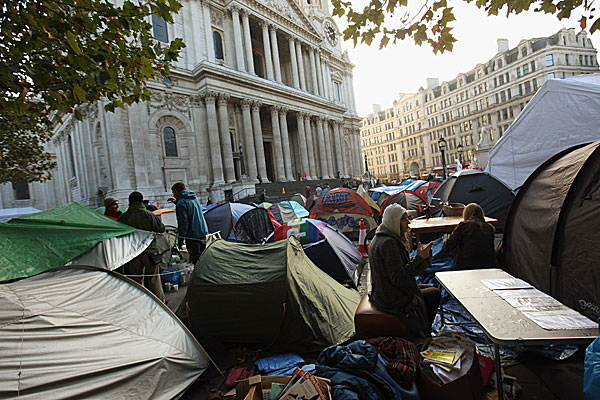
Campaigners on the 'Occupy London Stock Exchange' protest encampment outside St Paul's Cathedral on October 28, 2011 in London, England. (Oli Scarff / Getty Images)
The Church of England has had 468 years to work on its public relations strategy. The Occupy London protestors camped around St Paul’s Cathedral have had rather less time to perfect theirs. And when the two movements first collided on Oct. 15, it looked like experience would triumph over greenhorn enthusiasm. After the protestors’ befuddlingly odd attempt to emulate Occupy Wall Street by occupying the London Stock Exchange on a Saturday (the stock exchange operates 8am-4. 35pm Monday-Friday), the cathedral authorities permitted the protestors to pitch tents on their nearby doorstep instead. St Paul’s Canon Chancellor, the Reverend Dr Giles Fraser even asked police to move from their position outside St Paul’s. “I didn’t feel that [the building] needed that sort of protection,” he said.
Many in the British media initially backed Fraser’s stance, instead directing their ire against Occupy London, mocking the incoherence of the movement’s aims and using thermal imaging to claim most protestors were creeping away to more comfortable berths at night (that charge appears subsequently to have been debunked in this video). Some liberal commentators hailed the church’s renewed sense of mission in austerity-torn Britain. From this silk purse the church has fashioned a pig’s ear of monumental proportions and after its Oct. 28 decision to join legal action to evict the happy campers, things can only get worse.
It all comes down to a schism in St Paul’s and the wider Church of England. Nobody does schisms better than Anglicans. The schism within St Paul’s pitted Fraser against some of his colleagues, especially after the Oct. 21 decision to close St Paul’s reportedly on tenuous concerns that visitors might trip over guy ropes (there were real concerns—damage to local trade, issues of hygiene—but the tents have been pitched on concrete so the danger from ropes seemed, at best, remote). Church coffers could not sustain the loss of income from the closure indefinitely. Fraser resigned, as he told the Guardian newspaper in this long interview, after the church decided to initiate a legal process he could not condone. His “red line,” he said, “was about using violence in the name of the church to clear people on.”
Unless the protestors agree to move, it now certainly seems likely that they will be evicted, with however much force that entails. On Oct. 28 the City of London Corporation, the municipal authority for the area, voted to proceed with court action to remove the tents; at the same time St Paul’s re-opened for a service—and for business—issuing a statement. Its crux:
The Chapter has previously asked the encampment to leave the cathedral precinct in peace. This has not yet happened and so, following the advice of our lawyers, legal action has regrettably become necessary.
The statement also professes support for Occupy London’s aims. (“Theirs is a message that the Chapter has both heard and shares and looks forward to engaging with the protestors to identify how the message may continue to be debated at St Paul’s and acted upon.”) The sentiment is likely to ring hollow with the protestors and their supporters. A scabrous cartoon of Anglican leaders, surrounded by riot police on the steps of St Paul’s, singing “Mammon, How I Love Ya,” shows how a potential PR bonus has curdled into something dangerously toxic.
Meanwhile the internal disagreements at St Paul’s over how to respond to Occupy London are finding echoes across the Anglican community. “What Would Jesus Do?” asks a placard erected by the protestors outside the cathedral. It’s not an easy question to answer but He surely understood the importance of clear and consistent messaging.
Catherine Mayer is London Bureau Chief at TIME. Find her on Twitter at @Catherine_Mayer or on Facebook at Facebook/Amortality-the-Pleasures-and-Perils-of-Living-Agelessly . You can also continue the discussion on TIME’s Facebook page and on Twitter at @TIME .