


Israel's Foreign Minister Avigdor Lieberman, left, greets the Chairman of the Tripartite Bosnia Presidency Zeljko Komsic in Sarajevo October 27, 2011. (Photo: Dado Ruvic / Reuters)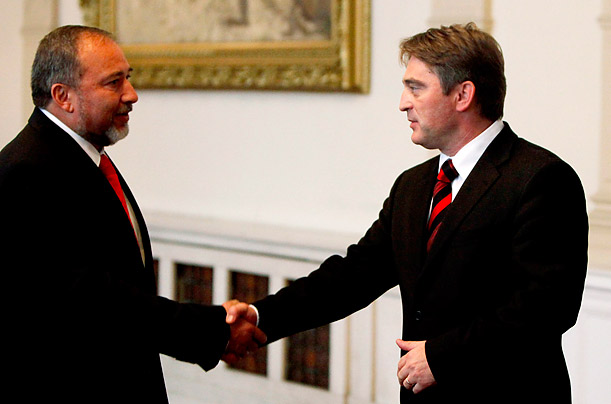
Everyone talks about the United States using its Security Council veto to stop the Palestinian application for UN membership, but there’s another calculation driving the most intense diplomacy now bubbling around the UN bid: If the Palestinian bid doesn’t get nine votes from other members of the Security Council, Washington won’t have to uncork a veto, sparing the Obama administration the mortification of sole, conspicuous responsibility for vanquishing the dreams of self-determination for a Palestinian public in the very year Obama celebrates the Arab Spring.
And so we found Mahmoud Abbas, the president of the Palestinian Authority, a few days ago in Bogota, mountain capital of the Colombia, a swing vote on the Council. And on Thursday who should pitch up in Sarajevo, mountain capital of Bosnia-Herzegovina, another pivotal UNSC seat, and officially undecided? None other than Avigdor Lieberman, the Israeli foreign minister.
A “yes” from either would put Palestine on the map, so to speak, or at least Washington on the spot. Ramallah counts eight council votes so far in its pocket: South Africa, India, Brazil, Lebanon, China, Russia, Nigeria and Gabon. Its best bet for a ninth vote is thought to be from among Portugal, Colombia and Bosnia-Herzegovina, one of the Balkan sovereigns that resulted from the detonation of that Cold War relic known as Yugoslavia. Portugal is a bit of a cipher, its decision-making wrapped up in, or perhaps masked by, the European Union foreign policy apparatus. Colombia is a very tough get for the Palestinians, given the billions Bogota has swallowed from the U.S. in military aid over the last decade.
And Bosnia-Herzegovina? True to its hyphen, the country’s politics are hideously complicated, even for the Balkans. It has — count ’em — three presidents, one for each of the resident ethnicities. The Bosnian president representing the Muslim population stands foursquare behind the Palestinian bid. The Bosnian president representing the Serb population stands foursquare against. And the Bosnian president representing the Croat population? He released the following statement: “The presidency of Bosnia-Herzegovina does not have a single view about the issue, while such decisions must be taken through consensus.” In other words, the Croat is caught in the middle.
Both sides have cards to play. The Palestinian Authority was very quick to recognize Bosnia as a state when it announced its secession from Yugoslavia in 1992. Since then, Muslim nations have poured substantial aid into the nascent state. These things matter and if they did not come up during the visit Abbas paid to Sarajevo in August, his foreign minister, Riyad al-Maliki, would refresh his host’s memories when he showed up Friday, the day after Lieberman left.
On the other side, Reuters gently notes that Lieberman this year vacationed for a week in Banja Luka, the heart of the Republika Srpska, promising Israeli investment and, as a native of the former Soviet state of Moldova, perhaps exploring whatever common ground might be found with the Serbs, who during the Balkan wars enjoyed the sympathies of proudly Slavic Russia, at least.
For the Serbs, however, the real concern is Kosovo, the breakaway republic populated by ethnic Albanian Muslims whose war for independence from Belgrade was decisively backed by NATO warplanes in 1999. Since then, Kosovo has gradually edged toward statehood but has not itself managed to gain membership in the United Nations. (Kosovo’s problem in the Security Council is Russia, which as a permanent member also has a veto.) The Serbs of Bosnia fret that momentum for a Palestinian bid would bring wind into the sails of the Kosovo effort, as well it might. The question is whether Serbian solidarity on Kosovo will govern the ultimate stand of the Bosnian Serb president, Nebojsa Radmanovic, or whether his position might possibly be loosened by the leverage provided by some other lesser known but equally Balkan concern.
Or perhaps everyone will just move on to Lisbon.