

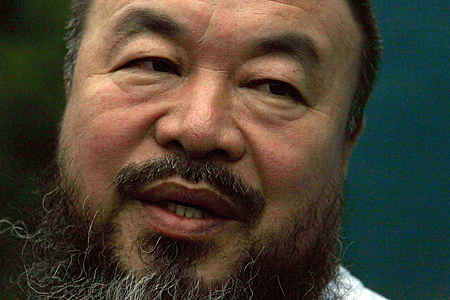
Dissident Chinese artist Ai Weiwei speaks to members of the media in the doorway of his studio after he was released on bail in Beijing, June 23, 2011 (Photo: David Gray / Reuters)
Ai Weiwei’s ordeal isn’t over. The artist and activist, who was released in June after three-months in detention, says the Chinese government is seeking $2.4 million in back taxes and fines from him. A notice delivered Tuesday ordered Ai to pay up within about 10 days, or face unspecified measures, reports the AP. The burly, bearded provocateur countered that he does not owe the money and could not defend his design studio, Beijing Fake Cultural Development Ltd, without access to accounting books that were confiscated. “It’s a game they play all the time,” he told the Guardian. “They needed an excuse to take me away for 81 days.”
The arrest and secret detention of China’s best known contemporary artist last spring called worldwide attention to what some consider the country’s most aggressive crackdown in years. Spooked by the unrest in the revolts in Tunisia and Egypt, the government has spent the better part of the year arresting and detaining activists, lawyers and intellectuals of all stripes. Though Ai, an outspoken government critic, had been detained before, some hoped his celebrity as an artist and his status as the son of a beloved revolutionary poet would lend him a measure of protection. Hardly. The 54-year-old spent 81 days in a 12′ by 24′ room and was interrogated at least 50 times, an experience he said amounted to “psychological abuse.”
Ai’s tax woes aren’t a total surprise. Shortly after he disappeared last April, a government official told the press the artist was being investigated for unspecified “economic crimes.” When he was released months later, he was served with a hefty bill. As my colleague Austin Ramzy notes, several government critics have found themselves targeted this way:
In recent years some activists and government critics have been targeted with accusations of financial wrongdoing. Wu Lihong, an environmental activist who campaigns against the pollution of Lake Tai in eastern China, was sentenced to three years in prison in 2007 for extortion, a charge he says was trumped up by local authorities. That same year Guo Feixiong, a legal rights activist, was sentenced to five years in prison for “illegal business activity” in connection with a book he wrote about a political scandal in northeast China. And in 2009 Xu Zhiyong, a lawyer, was investigated for tax evasion, and the Open Constitution Initiative, a legal rights organization he helped found, was forced to pay a $200,000 fine.
The famously outspoken Ai used his tax trouble to speak out on China’s justice system. Tax matters should not be handled by the police, he said. “I feel that a government or country must enforce laws in a clear and clean way,” he added. “This will protect the law. If you want to hurt one person, to hurt me, that’s all right, but what you’re doing is hurting the law. When you hurt the law, it hurts the country and everybody in it.”