


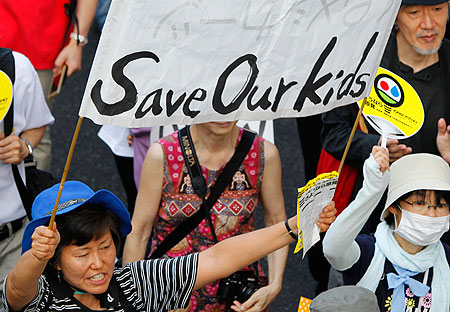
Several thousand people are marching in downtown Tokyo calling on the government to abandon nuclear energy, Sept. 19, 2011 (Photo: Koji Sasahara / AP)
The following is a guest post from TIME contributor Lucy Birmingham.
About 100 women from Fukushima, Japan, have started a week-long sit-in at a government office in Tokyo to demand greater protection for children affected by radiation. “Many children and their families are trapped in Fukushima because they can’t afford to move,” explains Ayako Oga, 38, a housewife living in the prefecture and one of the sit-in organizers. “The government has set the accepted radiation exposure rate too high.” Japan’s standard rate for exposure to radiation is 1 millisievert per year. For Fukushima residents alone the accepted exposure rate is up to 20 millisieverts per year. The International Commission on Radiological Protection considers this rate the top level and says it should not be exceeded over the long term.
The women are calling for two things. First, they want to protect children living in highly contaminated areas by giving them the officially sanctioned ‘right to evacuate.’ This would include government compensation and support that would enable children and their families to relocate on a voluntary basis. “A lot of children are trapped in the contamination because it’s so difficult [for their families] to afford leaving a mortgage or going to a place where there is no job available,” says Smith. “There are families that have done it, but under great hardship.” Secondly, they want to close down all nuclear power plants in Japan. “Fukushima women feel very strongly that there is no safe nuclear power,” says Smith “This is the lesson to be learned from Fukushima.”
The seeds of the sit-in were sown in September. A delegation of Japanese women protested in front of the United Nations building in New York City while Prime Minister Noda attended the UN summit on nuclear safety. Among the group was Sachiko Sato, an organic farmer, and her two teenage daughters who had been living about 30 km from the Fukushima plant. As Noda and UN Secretary-General Ban Ki-moon shook hands outside the building in front of the press, Sato stood in the background shouting into the megaphone, “You can’t even protect the children of Fukushima, how dare you talk about nuclear power safety!”
Back in Japan, Sato and volunteers formed the “Fukushima 100” contingent and organized the METI sit-in. As OF Oct. 1, the event had brought together over 2,300 participants from throughout Japan. Along with press conferences and leaflet handouts, the women have been forming a human chain around the ministry with shouts of “Women don’t need nuclear power! Women will protect children! Women will change the world!”
Change is needed, but the demonstrators face considerable opposition. During a meeting between government officials and thirty of the “Fukushima 100” on Oct. 27, a representative of the Nuclear Sufferers Life Support Team focused on the government’s efforts to clean up the contaminated areas. However, a comprehensive plan for handling the contamination has yet to emerge. (A new cleanup law will not be implemented until January.) The women have asked for a response from the state by Nov. 11—exactly eight months after the deadly quake.
More from Time.com: A Long Road to Recovery