


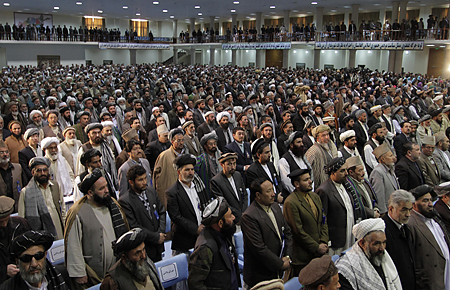
Afghan delegates of loya jirga, or grand council, stand to honor the Afghan national anthem during the opening ceremony of the assembly in Kabul, Afghanistan, November 16, 2011. (Photo: Musadeq Sadeq / AP)
‘Tis the season. The season of talks on Afghanistan, that is. Two weeks ago it was Istanbul, where Afghanistan’s neighbors met to discuss their roles in the country’s stability going forward. Early next month it will be Bonn, Germany, where the rest of the world will convene to ask, again, “whither Afghanistan?” And today, in Kabul, some 2000 Afghan influentials have gathered at the invitation of President Hamid Karzai to decide what kind of future relationship they want with the US, and the Taliban. Will the combined output of hot air do anything to lift Afghanistan out of its current quagmire? So far it doesn’t look promising.
Karzai opened the Traditional Loya Jirga, or council of elders meeting, with an exhortation to balance the country’s need for ongoing international assistance as the US and NATO troop presence draws down with a wish to see Afghanistan maintain its agency. “We want to have a strong partnership with the U.S. and NATO, but with conditions,” Karzai said. ” We want our national sovereignty, and an end to night raids and to the detention of our countrymen. We don’t want parallel structures alongside our government.”
The Jirga, which has no legislative powers, is meant to be consultative. Critics argue that Karzai is merely seeking political cover for an eventual agreement with the U.S. that is bound to be unpalatable not only for some Afghans, but for Afghanistan’s neighbors, who have little desire for a continued U.S. presence in the country past the 2014 deadline for American troop withdrawal. That may be the case, but Karzai’s bold opening statement also seemed directed at US administration observers. For the past several months Afghan government officials have been very clear that they want to see continued US investment and commitment in the country well beyond the deadline. By getting representatives from all of Afghanistan’s 34 provinces to agree on the terms of continued U.S. presence (Jirgas, a traditional dispute resolution mechanism, generally work towards consensus) before the formal agreement is finalized, Karzai can convincingly present the Americans with a united front. It’s a high stakes gamble: Karzai’s conditions—an end to night raids, Afghan control of detention facilities, funding that goes directly to the government—are highly contentious.
The secondary goal of the Jirga, determining the best path to peace with the Taliban, is likely to engender more fevered debate. Since the assassination of Afghanistan’s premier peace envoy Burhanuddin Rabbani, reconciliation efforts with the Taliban have largely collapsed. Former militia leaders of ethnic groups that have been traditionally allied against the largely Pashtun Taliban hold that peace can only be achieved through a military defeat. Others argue that it’s too late – negotiations are the only way forward. In the Asia Foundation’s annual survey of the Afghan people, released yesterday, Eighty-two percent of respondents supported the government’s attempts to address the security situation through negotiation and reconciliation with insurgents. It’s not so clear, however, that the Taliban are interested in being reconciled. Just a few days before the Jirga’s opening, the Taliban released what it said was the gathering’s security plan and promised to disrupt the meeting with violence. Whether they intended to follow thorough with their threat or were dabbling in psy-ops in order to intimidate delegates, as the Afghan government claims, is immaterial. Either way they want the meeting disrupted.
The Jirga, with its photogenic display of colorful headgear and dashing capes, may embrace tradition, but parliamentarians argue that it is unconstitutional. Such issues of national import, they say, should be discussed by the people’s elected representatives, not tribal leaders and influentials hand selected by the president and his supporters. Any resolution that comes out at the end of the three day meeting is likely to be met with dispute and skepticism if it differs significantly from parliamentary opinion, further dividing the public over important national issues at a time when it most needs to come together. Hot air may be a waste of time, but it’s usually harmless. This time however, it could ignite a political conflict at a moment when the country needs to unite more than ever.
Aryn Baker is TIME’s Middle East Bureau Chief, based in Beirut. Find her on Twitter at @arynebaker. You can also continue the discussion on TIME’s Facebook page and on Twitter at @TIMEWorld.