


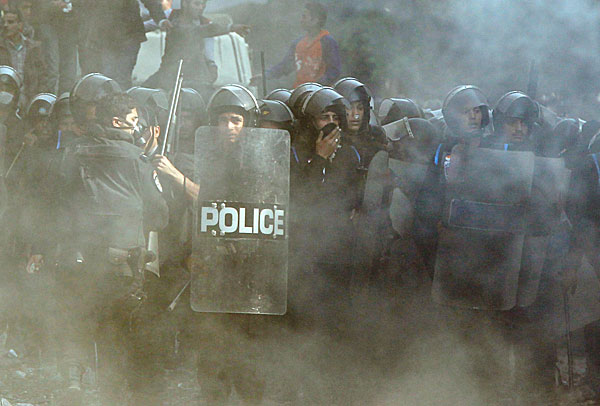
Riot police and a plain clothes policeman stand together during clashes with protesters on a side street near Tahrir Square in Cairo November 22, 2011. (Goran Tomasevic / Reuters)
Tens of thousands of Egyptians are once again filling Cairo’s Tahrir Square in defiance of an authoritarian regime, and paying for their stand in blood and pain as security forces fire tear-gas, rubber bullets and even in some instances live ammunition. But the crowds are no longer chanting “The Army and the people are one hand!” as they did in the January rebellion that ended the 30-year rule of President Hosni Mubarak. That slogan had always been wishful thinking, particularly when applied to the Mubarak-appointed generals that eased the strongman into retirement and claimed power for themselves last February. Tuesday’s crowd chanted “The people want the fall of the Marshall,” referring to Field Marshall Hussein Tantawi, the 76-year-old head of the military junta that replaced Mubarak, and has since moved to consolidate its own power. Tantawi in an unprecedented televised address to the nation on Tuesday insisted that the transition as authored by his Supreme Council of the Armed Forces (SCAF) would continue as planned, albeit with an expedited transfer of power to a civilian president next July. As for the protesters’ demand that the junta stand down, Tantawi answered that they’d do so only if that was the verdict of a popular referendum — apparently betting that the protesters in the Square don’t necessarily have the support of the majority of the electorate.
SCAF is made up of generals appointed by Mubarak; Tantawi had been his last defense minister. And over four days of attacks (see photos) on protesters that have seen as many as 30 killed and more than 1,500 wounded, those generals have reminded Egyptians that, in fact, theirs is the hand of authoritarian repression. Indeed, the single greatest cause of the latest political crisis in Egypt appears to be the junta’s inability to learn the lesson of Egypt’s recent history — and that of its neighborhood — that killing unarmed protesters only inflames resistance and negates whatever legitimacy those in power might claim.
The generals appeared to be scrambling for legitimacy on Tuesday, Tantawi offering to advance the date for presidential elections to open the way for a handover to civilian government to next July. SCAF has also reportedly offered the job of interim prime minister to liberal champion Dr. Mohammed ElBaradei after the last military-appointed cabinet resigned en bloc on Monday. ElBaradei, who had urged the military to step down and hand executive authority to a civilian “government of national salvation” was reported to be hesitating, unsure of the extent of authority he was being offered.
The protest that began last Friday over the attempt by SCAF to dictate terms for a new constitution that would not only exempt the military from civilian political oversight, but would codify for the generals a “guardianship” role over democratically elected institutions, turned bloody only when the security forces tried, on Saturday, to violently evict demonstrators from Tahrir Square. More than anything else, it has been the violence of the authorities that has escalated the standoff, multiplying the crowd in the square by a factor of ten. And in unleashing state violence against the demonstrators — creating a flurry of emblematic images of brutality instantly disseminated the country — the junta has made business-as-usual untenable.
But SCAF’s plans to reserve for itself a Pakistan-style final word over the political process isn’t the only element of the transition thrown into doubt by the clashes in Cairo and other cities. Voting in parliamentary elections is scheduled to begin on Nov. 28, but the country’s ability to hold a credible election amid the current security chaos has been called into doubt, although Tantawi on Tuesday insisted the vote would go ahead as planned. The question of elections and interim governments highlights an important division within the camp of those ranged against the SCAF. The liberal opposition, and the core element of young revolutionaries in Tahrir Square, had previously opposed early elections, and instead demanded handover of power to a civilian government appointed from among the key political factions. But the Muslim Brotherhood, the largest opposition group and the one predicted to emerge with the major share of votes from a democratic poll, insists on the vote going ahead on schedule. The Brotherhood, in fact, refused to officially back Tuesday’s demonstration in Tahrir Square, although many of its younger members — increasingly frustrated by the caution of the movement’s older leadership — have joined the protest.
The situation on the street remains fluid: protesters are clearly not ready to accept SCAF’s latest promises on a timetable for ceding power, liberal leaders are unsure of how to respond to the opportunity to serve in an interim government under the junta’s authority while those on the streets are demanding the junta stand down immediately. And the Muslim Brotherhood leadership appears to be calculating that a silent majority of ordinary Egyptians have little appetite for a return to the streets and the turmoil of last January and February. Still, in the latest round of Egypt’s game of thrones, the players have so far made their opening moves. Much could change in the days ahead.