


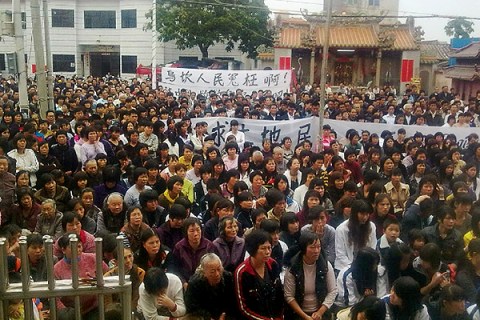
This undated handout picture shows thousands of residents protesting against local officials forcibly taking their land without compensation in Wukan village, in south China's Guangdong province on December 14, 2011.
In the southeastern Chinese province of Guangdong, a village is under revolt. Residents of Wukan, population 20,000, have been protesting the sale of their lands by local officials for months. The dispute escalated after the local government announced that Xue Jinbo, a villager who had been detained last week on suspicion of participating in a September protest, died in police custody. The authorities said the 43-year-old had died of a heart ailment, but his family and Wukan residents suspect that Xue, who was chosen by villagers a representative in talks with the government, was beaten to death. The public anger has turned the Wukan protests into a full-scale revolt, and created a serious problem for Communist Party officials at a time when other forms of unrest, including labor disputes, are rising and economic growth is slowing. Wukan now appears to be under siege.
Reports from the village are limited, but the Associated Press, quoting a resident, says local officials have fled the village and residents have barred police from entering for several days. Malcom Moore, a reporter for the U.K.’s Daily Telegraph who entered the village this week, wrote that food supplies have been cut off and that villagers have not been allowed to sail out of the village to fish, a major source of income. He also quotes Xue’s daughter, Xue Jianwan, as saying her father’s body had signs of abuse, including cuts and bruises on his face and blood in his nostrils. “His chest was grazed and his thumbs looked like they had been broken backwards. Both his knees were black,” she told the newspaper. “They refused to release the body to us.”
There is a precedent for this type of unrest, particularly in Guangdong. Four years ago I visited the village of Xiantang, in Foshan in central Guangdong. Villagers there had also protested, driven the local cadres out and occupied the local government headquarters for several months. The roots of the dispute then were very similar to what is happening today in Wukan. Residents complained that local officials had sold off farmland to build factories and housing, then skimmed the revenues for personal gain. Likewise, questions over land use were at the heart of a 2005 clash between police and residents of Dongzhou, a coastal village near Wukan. At least six people died when the authorities crushed that demonstration. So far, the situation in Wukan has not reached the levels of violence that Dongzhou saw six years ago. While it is unlikely the unrest will spread beyond Wukan, it could certainly escalate there. Villagers are reported to have been preparing homemade weapons to maintain their blockade.
Guangdong is China’s richest and most populous province. Land sales there can lead to huge returns, and also offer great potential for corruption and abuse. What happens in Guangdong is followed closely by the media in nearby Hong Kong, where media outlets are able to report more freely than domestic news outlets. While commentary about the situation is censored on many mainland websites, some questioning of events in Wukan is emerging. On the Twitter-like Sina Weibo microblog searches for words such as “Wukan” or “Shanwei” are blocked. But one message referring to the situation there was reposted by nearly 4,000 people. “I hear that there is a new kind of cardiac disease. The condition of the dead is very strange,” it reads in part. “It has to occur while in detention. The fingernails of the deceased fall out, and their bones are broken.”
Austin Ramzy is Beijing correspondent for TIME. Find him on Twitter at @austinramzy. You can also continue the discussion on TIME‘s Facebook page and on Twitter at @TIME.