

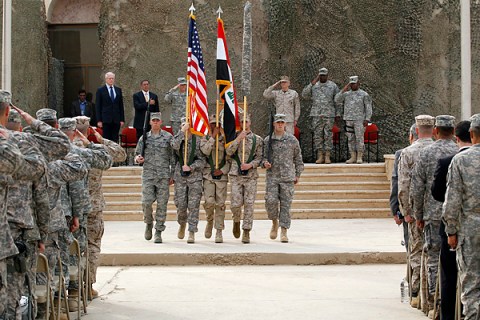
U.S. soldiers carry an Iraqi national flag and an U.S. flag during a ceremony to retire the flags, marking the end of the U.S. military engagement at the Baghdad Diplomatic Support Center, December 15, 2011.
The no-show by Iraq’s President Jalal Talabani and Prime Minister Nouri al-Maliki at Wednesday’s departure ceremony that officially closed the U.S. military mission in Iraq spoke volumes: Chairs with name cards reserving them for the two Iraqi leaders were quickly occupied by U.S. soldiers, but the fact that the Iraqi leaders failed to show up to publicly thank the Americans for “Operation Iraqi Freedom” was a painful reminder of the limits of what the war had achieved.
Saddam Hussein has gone, but at a cost to his own people of almost nine years of war, civil strife, terrorism and occupation that left more than 100,000 Iraqi civilians dead and millions displaced from their homes, infrastructure destroyed (water and electricity supplies in Iraq remain patchy even now) and the country’s social fabric torn apart. Of the 1.5 million American soldiers that cycled through Iraq, 4,487 were killed and tens of thousands left with debilitating physical and psychological scars. And the war has cost the United States some $1 trillion and counting.
Yet for all that horror and sacrifice, the Iraq that American forces leave behind is not especially stable, riven as ever by dangerous ethnic, political and sectarian fault-lines. Nor can the Iraq that the U.S. invasion has created be counted as a U.S. strategic ally in a wider Middle Eastern context. Iraq’s elected government is closer to Tehran than it is to Washington, although it is a puppet of neither, and in all likelihood uses the rivalry between them to enhance its own independence. But the Iraqi government is on the wrong side of U.S. policy throughout the region, from its attitude to Israel and its efforts to oust Syria’s President Bashar al-Assad, to its rejection of the U.S. effort to isolate Iran over its nuclear program. It’s an open secret in Baghdad that a key reason for Maliki’s government declining the agreement needed to keep U.S. troops in Iraq beyond this month was deference to Iran’s wishes.
Tehran’s strategic position, on the other hand, has been vastly enhanced by the elimination of its most dangerous enemy, Saddam Hussein (who had waged a brutal eight-year war against Iran with Saudi backing), and has used its close political and religious ties with the Shi’ite majority to ensure that the democratically elected government in Baghdad is a friendly — and Shi’ite — one. Whenever intra-Shi’ite disputes have threatened to allow anti-Iran elements to regain power, Tehran has intervened to broker compromises.
The combination of the horrors visited upon Iraq under U.S. occupation, and the failure of the massive show of American military force to bend the Iraqis to their will, havesharply diminished U.S. influence throughout the region. The year of the Arab Spring has shown that Washington’s ability to persuade its allies and intimidate its foes into compliance is dramatically reduced from what it had been in 2003. (Important to note, however, is the fact that the Arab Spring has also reduced Iranian regional influence: The zero-sum view Iran vs. the U.S. view of the Middle East has little traction with the Arab public.)
The architects of the Iraq war had promised a “demonstration effect” that would intimidate challengers and subdue the troublesome region, enabling the construction of a “new Middle East” on terms favorable to America. Instead, the U.S. departure sees American influence diminished, with Islamist Parties the likely inheritors of the fall of the dictatorships of Tunisia, Egypt and Libya, and the rest of the region — notably such U.S. allies as Israel, Saudi Arabia and the Palestinian Authority — acting independently of Washington’s preferences. A new Middle East, indeed; one that has relinquished Pax Americana and is writing its own history on terms that hardly fit the vision that drove the Iraq invasion. The demonstration effect of “Operation Iraqi Freedom,” then, has been to show the limits of American military power to shape events.