


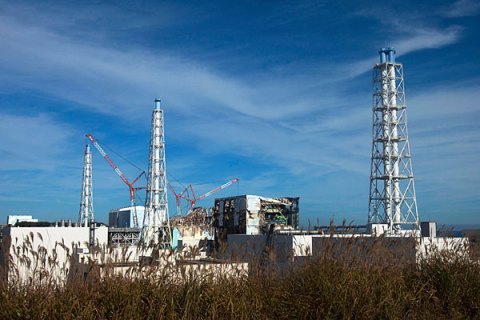
This Nov. 12, 2011 photo shows a view of the crippled Fukushima Dai-ichi nuclear power plant in Okuma, Japan.
Japanese Prime Minister Yoshihiko Noda announced in a televised address on Friday that the Fukushima Dai-ichi Nuclear Power Plant has officially reached a state of ‘cold shutdown,’ bringing the most urgent phase of the world’s worst nuclear crisis since Chernobyl to an end nine months after an earthquake and tsunami struck the plant on March 11.
According to Tokyo Electric Power Co., the massive utility that operates the embattled plant, temperatures inside reactors one, two and three, all of which suffered meltdowns after their cooling systems went offline in the twin disasters, now range from between 38C to 68C, and radiation is no longer leaking at the perimeter of the plant. Cold shutdown, according to the International Atomic Energy Agency, is reached when “the reactor pressure vessel’s temperature is less than 100C, the release of radioactive materials from the primary containment vessel is under control and public radiation exposure by additional release is being significantly held down.”
For all its heft, Friday’s announcement has been met with only measured enthusiasm. For some, the timing is a little too convenient not to raise suspicion: Just weeks after the disaster, Tepco declared that it would achieve cold shutdown by January 2012. For others, using the benchmark of cold shutdown as the “conclusion” of the disaster, as Noda put it, distracts from the significant ongoing challenges entailed in decommissioning the plant and decontaminating the 12-mile exclusion zone from which some 90,000 people are still displaced.
Just weeks ago, Tepco acknowledged that as much as 45 tons of radioactive water had leaked out of a crack in a concrete vessel at the plant, some of which, the company said, may have reached the Pacific Ocean. Tepco had originally planned to be rid of the contaminated water that was used to cool the reactors by the end of the year, but workers are still busy purifying and disposing of more than 85,000 tons of it. That project will require its own clean-up process, too; filters and structures used to do the job require cleaning and disposal.
A recent panel of the Japan Atomic Energy Commission suggested that it would be another 10 years before workers can safely begin to remove melted fuel from Fukushima’s reactors, and even that estimate may be optimistic given how little is known about the exact condition of the melted fuel rods in the stricken reactors. “Much time is needed for preparation, possibly more than 10 years, to get to know where the fuel is located and think about how work can proceed with minimum radiation exposure,” Tadahiro Katsuta, an associate professor at Meiji University, told the Mainichi Daily News. The government anticipates that decommissioning the plant, which includes fully dismantling the site and decontaminating it so it’s safe, will take at least 40 years.
There is no timeline for when tens of thousands of residents from the exclusion zone can think about heading home. Noda promised more money and workers would be dispatched to the region to speed up the decontamination process. “The government will do its best so that people who have been forced to leave their home areas can return home as soon as possible and reconstruct their lives,” the PM said on Friday. Until then, their lives are still on hold, and the crisis is far from over.
Krista Mahr is a correspondent at TIME. Find her on Twitter at @kristamahr. You can also continue the discussion on TIME’s Facebook page and on Twitter at @TIME.