


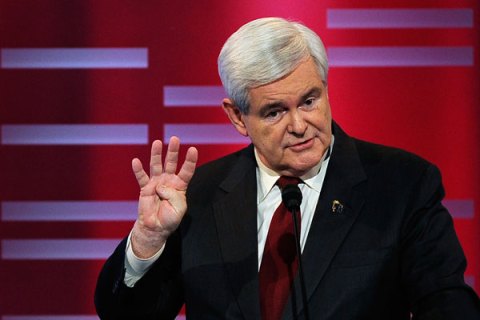
It made for dramatic television, Newt Gingrich’s screed against the Palestinians. Defending his earlier assertion that they are “an invented people,” the former House speaker kicked things up at notch at a Dec. 10 debate in Des Moines. “Somebody oughta have the courage to tell the truth: These people are terrorists. They teach terrorism in their schools. They have textbooks that say, ‘If there are 13 Jews and nine Jews are killed, how many Jews are left?’ We pay for those textbooks through our aid money. It’s fundamentally time for somebody to have the guts to stand up and say, ‘Enough lying about the Middle East.'”
The truth, however, seems to be that no such textbook exists. That’s the word from groups that have been studying Palestinian (and Israeli) textbooks for years, trying to encourage understanding across the divide that some American politicians appear more inclined to see widened. The Associated Press went hunting for the vivid example Gingrich cited with such confidence but could not find it, uncovering only dismay among researchers who have been diligently scouring textbooks for what Israel officials call “incitement.” Indeed, as the West Bank government headed by prime minister Salam Fayyad works to remove incendiary vitriol from Palestinian public discourse, these instances are becoming harder to find.
Yossi Kuperwasser, who compiles the “Incitement and Culture of Peace Index” for the Israeli government, insists that the hatred is out there. “They don’t call for immediate violence most of the time,” he acknowledges to TIME, “But when it comes to the culture of promoting violence, it’s all over the place.” Kuperwasser’s latest report repeatedly condemns Palestinian politicians for honoring high profile “martyrs” who carried out terror attacks in the past, an implicit endorsement of terror. In Palestinian society that’s viewed as honoring war dead, but it creates a real tension with those politicians’ renouncement of terror ( just as ordering the removal of posters and billboards memorializing less celebrated martyrs — once common on the streets of Nablus; now absent — may suggest they mean what they say).
Nothing in Kuperwasser’s index, which was not part of the AP survey, comes close to the arithmetic problem Gingrich described. It’s a zero-tolerance survey, including some examples that appear dated or obscure — the worst were posted on Internet message boards — and others drawing on what amounts to political disagreement. For example: While the office of Prime Minister Benjamin Netanyahu found “incitement” in atlases that have shown the country labeled “Palestine” extending to the sea (that is, taking in the area that in 1948 became Israel), AP notes that some Israelis texts show Israel extending not to the 1967 Green Line but all the way to the Jordan River — erasing the Palestinian claim to the West Bank, occupied by Israeli troops since 1967 and now home to hundreds of thousand of Israeli settlers.
Competing claims for the same land is, of course, the heart of the conflict, so anyone looking for trouble will have a feast with maps. The larger question is whether Palestinians “teach hate,” as Gingrich and another Republican candidate, Michele Bachmann, insist. The answer for Kuperwaser is yes: “You cannot praise terrorists.” The AP, meanwhile, quotes researchers who are more in line with the impression taken away from visits to Palestinian classrooms: While there’s plenty of hard feelings on both sides – and Hamas, which controls the Gaza Strip, remains largely captive to its extremist rhetoric — the reality on the West Bank is far more nuanced and, generally, more positive than what passes for debate in the U.S. presidential contest. Yet the West Bank, controlled by the secular Fatah party, is the part of the Palestinian political establishment that American politicians are moving to punish by withholding aid dollars.
Of the many delicate realities obscured by the dust kicked up in the Republican candidates’ stampede to appear Israel’s best friend, one is that the West Bank government works closely with Israeli security services, whose officials publicly argue for encouraging Fayyad’s government, not stripping it of funding that helps keep Israelis safe. Also obscured are the efforts by some in the Jewish State to harden its own curriculum. We know of these because Israel not only has a free press but a vibrant civil society that appreciates satire at the level of this prime-time send-up of right-wing efforts to indoctrinate kindergarteners. Saturday Night Live could take a lesson.