

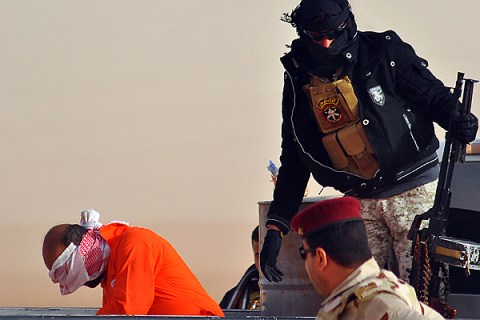
An Iraqi security force officer stands guard over one of three suspects (in orange jumpsuit) accused of taking part in the killing of Shiite Muslim pilgrims, on December 26, 2011, close to the western city of Ramadi, in the Sunni Muslim dominated province of Anbar.
Even when it had 140,000 troops in the country, the U.S. had precious little influence over the choices made by Iraq’s government — from the moment the Bush Administration was forced in 2004, by Iraqi popular pressure, to concede that Iraqis would choose their own government (rather than be ruled by Iraqis chosen by the U.S. for an extended period), the country’s political fate has effectively been out of Washington’s hands.
The Republican critics who insist that President Barack Obama threw Iraq to the wolves forget the inconvenient fact that Iraq’s democratically elected government refused to give them a legal basis to remain in the country. Still, having invested so much American blood and treasure in Iraq, the U.S. public may be inclined to see Washington as bearing some responsibility for the outcome there. (And, perhaps more importantly, Washington’s traditional allies in the region see the U.S. as responsible for the outcome of an invasion they counseled against.) So, while he might have opposed the war to begin with, events in Iraq in the New Year could nonetheless land at Obama’s door. And the President’s valedictory address on the war that spoke of a “successful, democratic Iraq becoming a model for the entire region” is sounding distinctly Pollyannaish: Iraq is showing signs of turning into an increasingly bloody mess in the New Year.
The wave of terror attacks against mostly Shi’ite civilians that killed 73 people last week and continued this week are a graphic illustration of the consequences of the sectarian schism that has widened in recent weeks in Iraqi politics. Prime Minister Nouri al-Maliki appears to be hardening that divide by systematically targeting leading Sunni political rivals to his Shi’ite dominated government, who are backing Kurdish-style autonomy for three predominantly Sunni provinces northwest of Baghdad, and who are warning that Maliki’s attacks risk rekindling the Sunni insurgency that bedeviled the U.S. occupation.
Al-Qaeda was marginalized in Iraq when most of that insurgency aligned with the U.S. in the “Awakening” movement, but those Sunnis who fought alongside the Americans (and on their payroll) against the jihadists were never reconciled with the Shi’ite dominated Maliki government. The alienation of the Sunnis from the new political order therefore creates a more permissive environment for al-Qaeda types to operate, and the collapse of the political contract in Baghdad that ties the major ethnic and sectarian factions to the political process therefore threatens major instability in the coming year.
Maliki, both by measures of votes in parliament and control of men under arms, is stronger than any other faction leader in Iraq right now, but he’s not strong enough to rule Iraq on his own. Indeed, he has the job of prime minister only because Iran — mindful of the importance of keeping a friendly government in Baghdad — intervened to convince rival Shi’ite leaders, most important among them being Moqtada al-Sadr, to back another Maliki term.
But other neighbors, particularly those at odds with Iran such as Saudi Arabia and Turkey, have other ideas. Both backed the Sunni-dominated Iraqiya bloc that challenged Maliki, and Saudi Arabia has been engaged in proxy conflicts with Iran across the region. A breakdown in Iraq’s governance and a renewal of sectarian violence — exacerbated by the increasingly sectarian civil war in neighboring Syria — could draw in all of Iraq’s neighbors and presage its breakup.
Avoiding a politically damaging catastrophe in Iraq may well depend on the willingness of some of its neighbors, particularly Iran, to impose some discipline on the sectarian impulses of their allies in Baghdad. As with much else in the Middle East these days, that’s a eventuality that’s largely out of U.S. hands.