


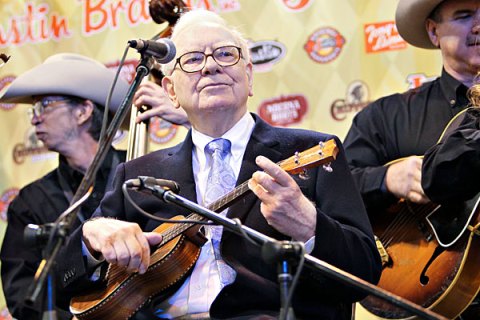
Warren Buffett, chief executive officer of Berkshire Hathaway, plays the ukulele during a tour of the exhibition floor prior to the Berkshire Hathaway annual meeting in Omaha, Nebraska, U.S., on Saturday, May 1, 2010.
Each year, China’s state television behemoth CCTV unleashes a five-hour variety show for Chinese New Year. The TV gala usually includes twirling children and armies of acrobats, aggressively cheerful ethnic minorities and rousing patriotic songs. (Last year, the CCTV extravaganza’s “ethnic dance” was the rather unsubtle “Big Happy Family,” while another dance was entitled “Powerful Workers.”) The majority of Chinese households tune in, making it one of the world’s biggest annual television events. Even more people watch if you count the extended Web version available through CCTV’s online sister organization. This year’s web broadcast, according to state newswire Xinhua, will include an unusual guest: Warren Buffett.
The American investment guru has strummed his ukulele at Berkshire Hathaway board meetings and has rocked a guitar in an American TV commercial. Xinhua reported that Buffett had recorded a video specifically for the Chinese New Year show. Wang Pingjiu, a CCTV executive, was quoted by the state newswire saying: “We all know that Buffett is good at investment, but few knew he also did well in singing.” It’s not clear what song the 81-year-old will perform nor whether his segment will play only online or on the shorter televised show due on Jan. 23.
This is not Buffett’s first foray in China. The head of Berkshire Hathaway made a high-profile investment in Chinese electric carmaker BYD, which elicited much rejoicing in the green community and rather less in the way of financial profit. In 2010, the Oracle of Omaha and fellow philanthropist Bill Gates were inadvertently involved in a financial controversy when a Beijing banquet hosted by the pair elicited grumbles from members of China’s gilded class who worried they might be hit up for donations. Although China’s billionaire ranks are second only to the U.S.’, the culture of giving is not as firmly established.
News of Buffett’s upcoming appearance at Chinese New Year, or Spring Festival as it is also called, came the same week that a Chinese Communist Party (CCP) magazine published a cultural essay based on a speech given last year by Chinese President Hu Jintao: “International hostile forces are intensifying the strategic plot of Westernizing and dividing China, and ideological and cultural fields are the focal areas of their long-term infiltration.” The article mirrors a push by the CCP to both reduce the impact of foreign entertainment in China and trim Chinese clones of Western shows that are considered “excessive entertainment.” (Already, China restricts the number of foreign films that are allowed in local theaters to 20 a year, although pirated copies of most movies are widely available.)
This month, the number of prime-time entertainment shows on Chinese satellite stations was slashed to 38, from 126, according to state media. What’s airing instead? Programs that promote “traditional virtues and socialist core values.” No confirmation yet on whether Buffett’s Chinese New Year routine will meet those criteria.
More from TIME.com: Stunning pictures of Harbin’s International Ice and Snow Festival.