


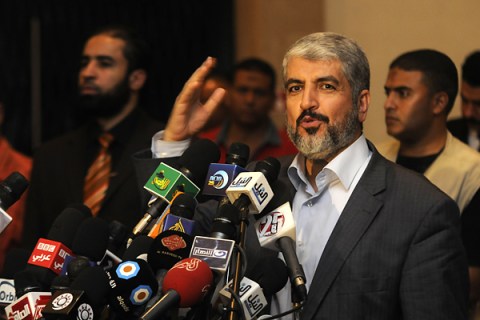
Exiled Palestinian Hamas leader Khaled Meshaal addresses a meeting with some 40 Palestinian prisoners who were freed by Israel but are to be deported overseas, in Cairo on October 18, 2011.
In what sure looks like further evidence of diminishing American influence in the Middle East, the country that summarily ejected Hamas a dozen years ago is opening its doors to senior leaders of the group Washington and Israel regard first and foremost as a terrorist organization.
Jordan kicked out Hamas way back in 1999 under pressure from the United States. The Palestinian organization had been anchored in Amman, but was forced to move its headquarters to Syria, where it officially remains. Life in Damascus has gotten mighty uncomfortable over the last year, however. Though the Islamic Resistance Movement has tried mightily to stay entirely out of the conflict between the Syrian government that is its host and the Syrian people that government has been shooting in the streets, it has not been a terribly comfortable neutrality, nor one that reflects well on a movement so proudly grassroots. Quietly, senior Hamas officials began moving their families out of Syria months ago, and despite routine denials, the organization has been looking for a new home for its headquarters, too.
Jordan will provide the former, but not the latter, Prime Minister Awn Khasawneh explains to TIME in an interview.
The idea is not to bring them back as a launching pad for jihad against Israel or whatever. But as individuals they should be allowed to come back. I thought from the very beginning that their expulsion was unconstitutional and it was the wrong move from the point of view that it stands to reason that if you have many alternatives for as long as possible, it’s the good sign of effective diplomacy.
Amman, the Jordanian capital, already provides a place for the leader of the other major Palestinian faction to rest his head. Palestinian Authority President Mahmoud Abbas, who leads the secular Fatah party, regularly sleeps in Amman while traveling in and out of the adjoining West Bank, which has no working airport. On the range of “alternatives” to resolving the conflict with Israel, Abbas champions negotiating a solution, while Hamas armed resistance. In recent weeks, however, as the rival factions have sought to reconcile, Hamas chief Khaled Mashaal has said the organization will put aside military means in favor of unarmed “popular” resistance, saying it’s the method all factions can agree on.
Mashaal, who was nearly killed by Israeli agents in a botched 1997 assassination attempt in Amman, will be among those setting up housekeeping in the Hashemite Kingdom of Jordan, roughly half of whose residents are Palestinians who made their way across the Jordan either in 1948, in 1967, or in the steady flow of “soft immigration” that has gone on since.
“We will be finding modalities to bring back members of Hamas and their families to come,” Khasawneh says. “We don’t want them to establish another organization here.”
As a new site for Hamas headquarters, Qatar is the nation most often mentioned. The petroleum-rich Gulf monarchy is both a U.S. ally and a longtime supporter of Hamas, a duality that clearly irked the Jordanian premier, given complaints from Washington over Jordan’s decision to renew hospitality. “I know that some people in the United States are against this,” Khasawneh says, “but Qatar, a much more erstwhile ally of the United States, enjoys their presence without anybody in Congress saying anything.”