


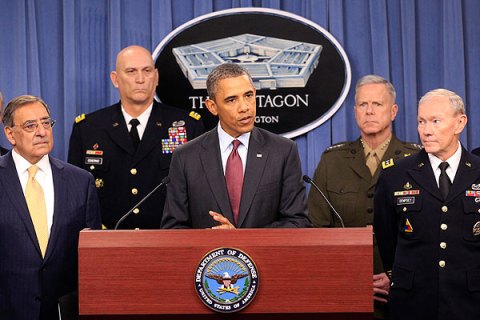
U.S. President Barack Obama speaks about the Defense Strategic Review at the Pentagon in Washington Jan. 5, 2012. Obama unveiled a defense strategy on Thursday that calls for greater U.S. military presence in Asia and envisions cutting troops in Europe as the Pentagon seeks to reduce spending by nearly half a trillion dollars after a decade of war.
When U.S. President Barack Obama announced earlier this month that the U.S. military would be re-orienting itself toward the Asia-Pacific—a move that many perceive as an attempt to counter China’s rising power—China’s state-run news agency, Xinhua, responded quickly. But instead of the usual blustery anti-Americanism, the piece was titled “Constructive US role in Asia-Pacific welcome.” Parts of the story were certainly less sunny than the headline, warning that America’s “possible militarism will cause a lot of ill will and meet with strong opposition in the world’s most dynamic region.”
Still, the headline’s positive spin—and the absence of pages more of aggrieved Chinese commentary in the following days—was telling. Here’s more from the Xinhua piece: “The US role, if fulfilled with a positive attitude and free from a Cold War-style zero-sum mentality, will not only be conducive to regional stability and prosperity, but be good for China, which needs a peaceful environment to continue its economic development.”
Beyond the state media’s response, the Chinese government has not yet officially commented on the U.S. military’s strategic shift. Sometimes it takes a while for the Chinese political bureaucracy to come to a consensus on how exactly it feels. It’s possible that a more combative Chinese position will be voiced the days ahead. And it’s not as if the Chinese government has been showering the West with warm-and-fuzzies of late, as was evidenced by the publication this month of an essay credited to Chinese President Hu Jintao that blamed “international hostile forces [for] intensifying the strategic plot of Westernizing and dividing China.”
Nevertheless, it’s striking that the Obama defense plan met with little initial Chinese blowback. By contrast, on Sunday, China’s Assistant Foreign Minister Liu Zhenmin, the country’s top diplomat on Asian affairs, was quoted in the China Daily, a state-run English-language newspaper, chiding China’s regional neighbors to “discard their ‘cold war mentality’ when handling sensitive regional issues…in the wake of China’s occasionally tense relations with its neighbors in Asia last year.” Maritime disagreements between China and Southeast Asian nations over the South China Sea have escalated in recent months, as Beijing has more vocally claimed southern waters as its domain. (The China Daily story did note that “forces outside the region”—translation: the U.S.—“should not intervene in South China Sea disputes.”) Territorial fracas with South Korea and Japan over waters and tiny isles to China’s east keep simmering, too.
Meanwhile, attacks on Chinese ships traversing the Mekong River through the Golden Triangle (where Thailand, Burma and Laos meet in a zone notorious for drug-fueled crime) have claimed more than a dozen Chinese sailors’ lives; the most recent assault occurred just this month, although no deaths were reported. Even in neighboring Burma, which has enjoyed close ties with Beijing, a massive Chinese-sponsored dam was suspended after local opposition to China’s influence mounted. For China, the American military’s rising influence in the Asia-Pacific is just one potential trouble spot in a neighborhood full of uneasy relations.