


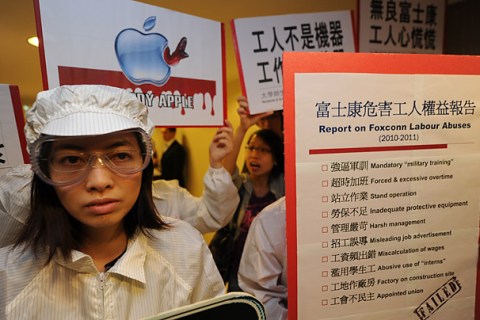
A group of protesters demonstrate outside the Foxconn annual general meeting in Hong Kong on May 18, 2011
Electronics-manufacturing giant Foxconn, which saw 14 employees commit suicide at its Chinese plants in 2010, has come under renewed pressure after a group of workers reportedly threatened to jump from a building last week. Microsoft is investigating reports that workers who assemble its Xbox game system at a Foxconn plant in the central Chinese city of Wuhan threatened to kill themselves in a wage dispute, CNN reported. Workers interviewed by the U.K.’s Daily Telegraph said the dispute centered around a move to a production line for the Taiwanese computer brand Acer.
Update: Foxconn said Friday that about 150 employees sought severance pay and an end to their contracts over a shift in production lines. After negotiations the workers left the rooftop and 45 decided to quit while the rest chose to stay on, Foxconn said.
Images of the protesting workers spread on Chinese microblogs, and molihua.org, a site run by people opposed to the Chinese government, compiled several photos that showed about 100 workers in winter clothing standing on a rooftop, with police and firefighters gathered below. The website said the workers dispersed after several hours on the roof. A Microsoft spokeswoman told CNN that the incident appeared to be due complaints over “staffing assignments and transfer policies, not working conditions.”
Foxconn is a subsidiary of the Taiwan-based Hon Hai Precision Industry, the world’s biggest contract electronics manufacturer with clients including Apple, Dell, HP, Microsoft and Sony. It has some 900,000 employees in China, including some 420,000 at its production base in the southeastern city of Shenzhen.
(PHOTOS: The Migrant Workers in Shenzhen.)
Workers at Foxconn factories are usually young and often spend long hours at monotonous tasks on assembly lines. A cluster of suicides in 2010, mainly by workers who jumped from Foxconn buildings in Shenzhen, brought the company under close scrutiny. (The Foxconn suicides still fell well below China’s officially reported suicide rate, which in 1999 was 13 men and 14.8 women per every 100,000 people.) In response to the high-profile deaths the company raised wages, installed safety nets on some buildings, offered counseling for distressed workers and held rallies in which employees were urged to “Love your life, love your family.” Last year three suicides were reported at Foxconn plants, indicating that the company may be making headway in curtailing the problem.
Even before the Foxconn suicide cluster, threats of suicide were used by factory workers in China. With weak workplace protections, employees sometimes feel forced to take extreme measures in pay disputes, as Philip P. Pan described in a 2003 story for the Washington Post. “These suicide threats are acts of desperation as much as depression, made by men and women who have concluded that China’s courts, trade unions and government agencies are unable or unwilling to help them,” Pan wrote. “These institutions are underfunded and understaffed, and often controlled by party officials who have close ties with local employers.” Such disputes are particularly common ahead of the Chinese New Year, which begins on Jan. 23 this year, as workers try to claim their pay before returning home for the holiday.