


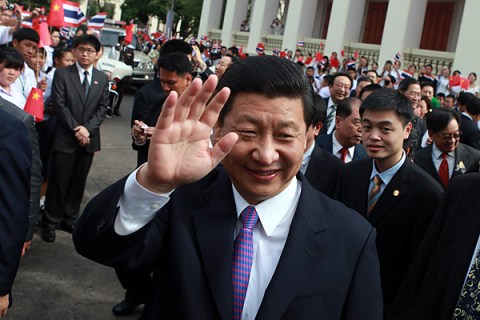
Chinese Vice President Xi Jinping waves to students during a visit to Chulalongkorn University in Bangkok on Dec. 24, 2011
The White House announced on Monday that Vice President Xi Jinping, the man most likely to be China’s next President, will visit Washington, D.C., and California next month. Also on his itinerary: Iowa. Washington is, of course, the nation’s capital and California its most populous state. Iowa, though, struggles a little harder for recognition. The state has just had its first-in-the-nation presidential caucuses, when it enjoys the national spotlight before another four years of anonymity. But Xi probably isn’t looking for tips on campaigning.
So why is Xi going to Iowa? For one, he’s returning to see some old friends. In 1985, Xi, who was then a Hebei provincial official and director of the Shijiazhuang prefecture feed association, visited Iowa as part of a sister state/province program. He stayed with a family in Muscatine and met Governor Terry Branstad. Branstad, who is once again Iowa’s governor after serving 16 years in the 1980s and ’90s, called on Xi during a visit to China last September. He says Xi kept the itinerary from his 1985 Iowa trip and named a number of people he met. Xi “was impressed with the hospitality and friendliness of Iowans,” the governor’s office says. Reconnecting with Iowans on this trip could help give Americans a more human image of the Chinese leader, not unlike Vice President Joe Biden’s “noodle diplomacy” at a small restaurant in central Beijing during his visit last August.
On the rare occasion when Iowa attracts a foreign leader, it is usually about agriculture. That was the case over half a century ago when Soviet Premier Nikita Khrushchev, following on a proposal by a Des Moines Register editorial writer for an exchange of agricultural know-how, visited a Coon Rapids farm in 1959. The visit is credited with easing Cold War tensions and giving Americans and Soviets a better appreciation for one another.
Fifty years later, agriculture will likely be on the agenda again. China has long tried to maintain self-sufficiency in grains, but the growing demand for meat has pushed up its imports of corn and soybeans. Despite its own bumper harvest, China made large purchases of U.S. corn last year, and record U.S. exports of agricultural commodities last year have helped keep unemployment lower in big farming states such as Iowa, Nebraska and the Dakotas. At a time of economic uncertainty, and worries about job losses to China, a trip to the heartland surely beats a photo op in California or D.C.
