


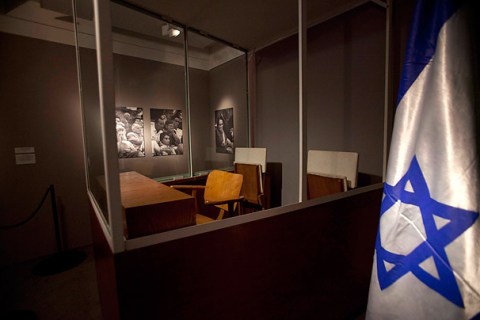
A wooden chair inside a bullet-proof booth where Adolph Eichmann sat in during his trial in 1961 is part of the display in the "Operation Finale" exhibit at Beit Hatfutsot, the Museum of the Jewish People, in Tel Aviv, Israel on Feb. 7, 2012.
“Operation Finale: The Story of the Capture of Eichmann” is a museum exhibition that chronicles the secret Mossad operation that stalked and captured Nazi war criminal Adolf Eichmann from his refuge in Buenos Aires, and smuggled him to Israel to stand trial for his role in organizing the Final Solution. Eichmann was the chief logistician of the Holocaust, and the exhibit at the University of Tel Aviv is satisfying in every possible way: Not only seeing justice done, but laying eyes on the homespun artifacts of early spycraft that made it happen, like the stubby metal needle that administered a sedative before the prisoner was led, dressed in the uniform of a flight navigator, up the staircase of the El Al plane that carried him across the Atlantic.
The exhibit, at The Museum of the Jewish People, has it all: The soft leather briefcase with a camera hidden inside, its shutter activated by a button on the bottom pressed by an Israeli agent who pretended to happen by the house on Garibaldi Street on day in 1960, inquiring about investments in the area. Here are the black and white images, captured at an upward angle, of the man calling himself Ricardo Klement: A thin bald figure gesturing with arms akimbo, some quality of arrogance on display along with the actual prints, their negatives, and even the cardboard sleeve of the Buenos Aries photo shop that developed them — “Optica ‘Florida’ Argentina 1960.”
PHOTOS: Adolf Hitler’s Rise to Power
The agents didn’t think it was Eichmann. But their sneaked photos were compared with a civilian portrait and the photo from his SS file – both also on display – by forensic experts who knew what to look at: Ears really don’t change. One expert sketched an oval of a head with 10 points of commonality enumerated on a piece of paper either brown in 1960 or faded since to that shade, like the Mossad file on Eichmann himself, code-named “Dybbuk,” Yiddish for an evil spirit that penetrates the soul.
The 11 agents dispatched to bring Dybbuk to Israel were a mix of Mossad, the intelligence agency that works overseas, and Shabak, Israel’s domestic security office, which had to be called on for help. “Besides being the Eichmann story this is the story of the evolution of the Mossad,” says Avinoam Armoni, chief executive of the museum, known in Israel as Beit Hatfutsot. Mossad — the massive organization whose hand critics see behind many a mysterious death abroad – was not all that back then. Its original mission was mostly getting Jews out of other countries and into newly established Israel.
PHOTOS: Kristallnacht in Words and Photographs
Today Mossad actually has a website; the “About Us” page is a good place to start. “It’s a bit of a change from the early days when you were not even allowed to utter the word,” says Armoni. But its reputation for omniscience, for being able to reach anywhere, began with the capture of Eichmann. The ruthlessness would come later, especially as Israel mounted an assassination campaign against Palestinian activists in response to the massacre at the 1972 Munich Games. (“Striking Back,” by TIME’s own Aaron J. Klein, is the definitive book on what some would deem the morally treacherous work carried out by Caesarea, as the agency’s assassination unit was known.) Indeed today, as Iranian nuclear scientists blow up on their morning commutes with startling frequency, it may qualify as news that Mossad actually brought an enemy back alive.
“Everybody wants to talk about Iran,” says Yossi Peled, the government minister who persuaded the Mossad to take the exhibition public. “I know of only one way to answer,” says Pellin, who lost his entire family except his mother at Auschwitz: “We the Jewish people were spread all around the world. In 1948, thanks God, history gave us a gift: We got our own country. But it’s a one-time gift. We have an obligation to protect ourselves.”
PHOTOS: Auschwitz After 65 Years
The exhibition is compact, accessible and alive with grace notes. The glass cases of documents and gadgets would have been plenty. Here’s a suitcase containing a machine to make license plates in a safe house – a long way from Stuxnet. Over here’s what Eichmann had in his pockets when he was pulled off the street outside his house: a pen knife, two keys, a cigarette holder, an ID card from Mercedes Benz, and a comb in a leather case. But the curator, a Mossad employee who goes only by Avner A., laced the artifacts with videos of retired Mossad agents (old men in book-lined studies, recalling their roles in the drama) and the singular art created during the mission. Zvi Malkin was an artist as well as a secret agent and Holocaust survivor. His cover in Buenos Aires involved wandering around the city with a guide book, using its pages as a canvas. Amid the brush strokes on a page headed, perhaps wryly, “Shipping and Exports,” you can make out the words, in Hebrew, “When will it be decided to take him to Israel?” And below, in English, “And never a word of forgiveness.”
Courtesy of the Mossad Archive From BH the Museum of the Jewish People exhibition “Operation Finale: The Story of the Capture of Eichmann”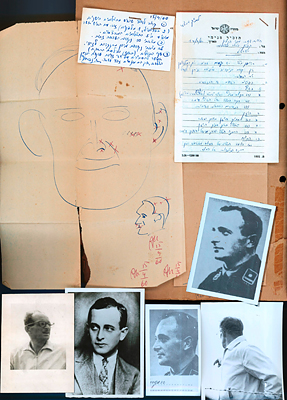
VIDEO: The March of TIME: Nazi Germany (1935)
“Until the Eichmann trial, in Israel no one spoke about the Shoah,” says Armoni, referring to the Holocaust by its Hebrew name. “There was this shame. Israelis said we would never allow ourselves to be taken like lambs to slaughter.” Indeed, by the 1940s the sturdy Zionists had spent decades creating not only the foundation for a future state, but also the model of a “new Jew,” a dynamic, martial, outdoorsy alternative to the stereotypical “scrawny weaklings” of the Eastern European shtetl. The reception that survivors found in Israel, which plays heavily on memories of the Holocaust for international sympathy, runs counter to the expectations outsiders bring with them. Says Armoni: “They have not always been treated the best here.”
But the daring of the Mossad — there’s something Israelis can agree on. The exhibition will run for three months, and may or may not travel overseas, according to Peled. The minister explains that it’s less a question of whether the Mossad qualifies as the ideal ambassador for Israel, but rather that the point of putting all this together is to reach young Israelis. “Talking with them about the capture of Eichmann,” he says, “is like talking about Napoleon.”